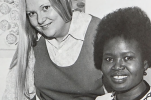

“In the concept of the Christian body,” wrote Carl Lundquist during his last decade as Bethel president, “every member is important and essential to the others. There are no 2nd. class members, only differentiated functions.” So it’s important to me that this project tell the stories of women who have filled a variety of roles at Bethel, from students and staff to campus pastors and coaches.
However, in drafting a paper articulating his “Philosophy of Educational Administration,” Lundquist did argue that faculty played a particularly important role in the life of a Christian college:
There is a sense in which all the rest of us serve to make its work possible, even though we too must find our personal satisfactions in what we do. But the heart of the campus is the classroom. The teacher with his student is at the cutting edge of what a school is about.

So I’ve spent a great deal of time in recent days trying to get as complete a picture as I can of the role of women on Bethel’s faculty: how the population of female professors grew over time, and which disciplines/departments were the fastest (and slowest) to hire women to teach. I’ll need to draw on other sources to humanize those stories, but as a starting point, I’ve done the best I can to use Bethel’s academic catalogs to do some preliminary quantitative analysis and to build a reasonably complete roster of Bethel’s women professors.
It’s putzy work, and I’m still not done. But there’s more than enough data here to justify multiple posts, so I’ll go ahead and share part 1 of this series today, then wrap up after I finish my catalog work.
One important caveat to note: I’m focused here on full-time faculty, not adjunct and other part-time faculty (e.g., administrators or retirees who teach a course or two), nor librarians whose faculty status has always been rather fuzzy at Bethel. I don’t mean to disparage any of that labor; it’s always been essential to academics at Bethel. But I have two reasons to keep my focus on full-time faculty:
- Including adjunct instructors would actually give us a warped sense of gender balance on the faculty, since for many years women at Bethel were much more likely to get that kind of part-time teaching work than the full-time roles that carried more responsibility and influence.
- Focusing on full-time professors makes it easier to compare apples to apples across time. Indeed, I started my quantitative analysis with the 1958-59 catalog in part because it was the first to distinguish consistently between full-time and other faculty.
Finally, I’ve focused on Bethel College (later, the College of Arts and Sciences), both because its catalogs — unlike those of the Seminary — have almost all been digitized and because the larger size of its faculty gives us a more meaningful sample to work with. But I’ll mention a couple of Seminary faculty today, to illustrate just how rare it was for women to teach there during this period in Bethel history, then try to fold in its faculty numbers — plus those of Bethel’s more recent adult and graduate programs — for the final project.
With all that out of the way, here’s some of what I found for the end of the Lundquist presidency and the start of George Brushaber’s tenure — broken into two spans of time, each with a graph showing the gender demographics of the (full-time) faculty, plus some observations from me.
The Last Years of the Old Campus, 1958-1972

1958 is also a good place to start because it was the year that Bible/religious education professor Esther Sabel retired after more than thirty years at Bethel and English professor Jeannine Bohlmeyer began a tenure that would last nearly as long (until 1988). While a generation would elapse before another woman followed Sabel in teaching Bible at Bethel College (and that wouldn’t happen at the Seminary for far longer), Bolhmeyer had a succession of relatively short-tenured female colleagues in her department on the Old Campus: Elizabeth Miller (1956-1960), Betty Jane Tutton (1961-1967), and Mary Sodergren (1966-1970).
German instructor Effie Nelson (who had started in 1925, a year after Sabel) would stay through 1967, sharing the Foreign Languages department with Lillian Ryberg (Spanish, 1948-1985), Ingeborg Sjordal (Swedish, 1944-1962), and Alta Jacobson (French, 1962-1968). Heidi Watschies taught German after Nelson’s retirement (1968-1976).
But apart from teaching languages and literature, women were sparsely represented on the faculty in these years, never reaching double digits and actually accounting for a declining share of faculty numbers (from 20% in 1958 to just over 10% as the Seventies began). At this point, women were shut out of the full-time faculties of Biology, Chemistry, Christianity, Mathematics, History, Philosophy, Political Science, Psychology, and Speech.
Ellen Lehr (1953-1961) taught business courses long before that field became a major, but education programs were coming on line after Bethel was finally accredited in 1959. Education chair Junet Runbeck (1962-1981) was a pivotal figure in the development of Bethel’s teacher training programs, and the Physical Education department — even before Title IX accelerated the growth of women’s sports on campus — included professors like Marilyn Starr (1961-1974, who also succeeded Effie Nelson as dean of women), Carol Morgan (1967-1976, who also coached basketball), and Patricia Brownlee (1968-1978, who would go on to become the first woman to serve as academic dean of the College).
The First Years on Lake Valentine, 1972-1986

Bethel’s early years in Arden Hills did see several long-serving women join the faculty, including Shirley Dawson (Physical Education, 1974-1986), Lorraine Eitel (English, 1975-1998), Shirley Olseen (Social Work and Psychology, 1975-1988), Vivian Anderson Swanson (Education, 1978-1994), and art educator Barbara Glenn (who returned as an adjunct instructor in 1975, then transitioned to full-time status in the Eighties). But overall, the last stage of the Lundquist presidency saw only slow moves towards gender equity. When he retired in 1982, women accounted for just 16% of the full-time faculty.
However, the College dean who succeeded to the presidency, George Brushaber, had already started to make some significant hires as part of his larger move to improve Bethel’s academic profile. Psychologists Lucie Johnson (1980-2010) and Kathy Nevins (1981-2022, having previously worked in student life and athletics) became pillars of the faculty for decades. Sharon Banister (Biology, 1980-1987) was the first woman hired to teach in the natural sciences, and Cheryl Meltzer (1980-1982) briefly provided a bit of gender diversity in Biblical Studies at a time when the only woman on the Seminary faculty (Jeannette Bakke) taught Christian education.
Still, when the 1983-1985 catalog broke with its usual practice and listed professors by department, men accounted for 16 of 17 in Math & Natural Sciences, 25 of 29 in the Humanities, 15 of 18 in Fine & Performing Arts, and 18 of 24 in Social & Behavioral Sciences. Back then that last department included Bethel’s new, growing Business program, which didn’t hire a woman until Marcia Bergren returned to her alma mater to teach accounting (1985-1991).
The most striking changes had taken place in two other professional programs. By 1983, four of the five Education professors were women, including Gloria Kortmeyer (1980-1994) and Judy Moseman (soon to become the first woman to serve as a Bethel vice president, as head of Student Life for twenty years); and so were all seven Nursing profs, including program founder Eleanor Edman (1981-1997) and Nancy Larson Olen, Beth Peterson, and Sandra Peterson (all of whom started in 1982 and taught into the 21st century).

The Nursing faculty — which remained all-female until the mid-Nineties — had grown to eleven by 1985-86, pushing women past the 25% threshold for the first time.
One goal of this blog is to help involve members of the Bethel community in doing the history of Bethel, so comments are always welcome! Just know that if you leave a comment at the project blog, I’ll take that as expressing your permission to quote it in the project.


Chris, you’re using the catalog, which is a great source. Have you thought about using IPEDS data? Talk with Dan Nelson or Joel Frederickson about access. Also really helpful for comparative data.
LikeLike
Rich: I’m planning to use IPEDS to help analyze student data (see https://womenofbethel.org/2024/09/16/bethels-most-gendered-majors) and may come back to it for aggregate faculty counts over time. But for the kind of analysis I’m doing with here, I preferred to do more painstaking work with catalogs — to ensure a more consistent counting of full-time College profs, and to help compile an actual list of who served when and in which departments.
LikeLike
Thanks for the feedback! And good work! Rich
>
LikeLiked by 1 person