Now that I’m back to teaching a typical spring load of three courses, I’ve had less time to dedicate to research. But I am setting aside a few hours a week to keep plugging away, in both the Bethel archives and our digital library. So as the week comes to an end, I thought I’d extend my “From the Archives” series long enough to share another kind of historical evidence that might help us understand the views of Bethel students on topics connected to the experience of women: two quantitative studies conducted by social science professors and students at Bethel.
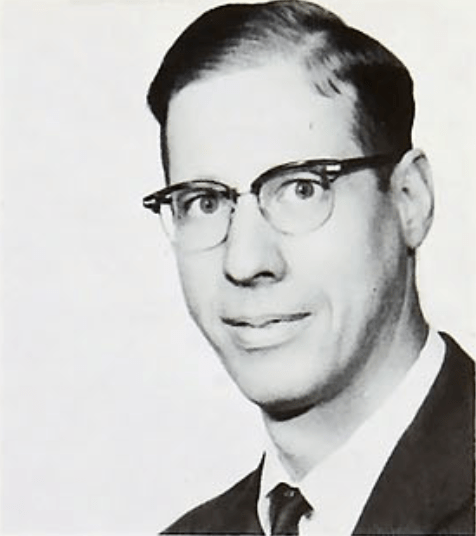
First, a multi-campus project by sociology professor David Moberg and four of senior Social Science majors in 1963 and 1964. They surveyed first-year students at the University of Minnesota, Bethel, and four other church-related colleges (Hamline, Macalester, North Central, and St. Paul Bible — later renamed Crown), asking them about their religious backgrounds and beliefs and their moral and ethical stances.
Canadian student Betty Bastien wrote the report on Bethel itself, after having surveyed 209 students — 56% of them women, who were even more likely than their male peers to identify themselves as Fundamentalists (68% of the women respondents claimed that term, either by itself or in tandem with one like Evangelical, Orthodox, or Conservative; overall, that figure was 61%). 72% of the Bethel sample gave their mother’s occupation as housewife, with secretary (8%) and teacher (6%) being the only professions named by more than 10 students. A slight majority (51%) reported that their mothers’ educations had stopped in high school or earlier, with 22% having completed college and/or graduate school.
Perhaps most interesting for us is the longest section of the survey, where respondents were given a list of behaviors and asked if each was “Always Wrong,” “Usually Wrong,” “Usually Right,” or “Always Right.” Below you’ll find a few of the Bethel results that may speak to issues common in the women’s history of that era:
(I’ve added the Macalester figures in italics to give some context. I’d rather have contrasted with the results from the University of Minnesota, as offering a better cross-section of 1960s youth, but that report was either never completed or left out of the file. The researchers were only able to survey 69 Macalester students, 64% of them women and 62% identifying as Liberal or Humanist in religious terms.)
| Behavior | Always wrong | Usually wrong | Usually right | Always right |
| Wearing cosmetics | 0% (1%) | 1% (3%) | 60% (46%) | 39% (49%) |
| Wearing short shorts | 18% (7%) | 49% (22%) | 25% (54%) | 8% (17%) |
| Wearing scant bikinis | 56% (22%) | 17% (43%) | 33% (25%) | 2% (10%) |
| Mixed male/female swimming | <1% (0%) | 1% (1%) | 48% (29%) | 50% (59%) |
| Dating person of another race | 37% (6%) | 53% (64%) | 9% (36%) | 1% (4%) |
| Kissing on first date | 22% (6%) | 63% (64%) | 14% (23%) | 2% (6%) |
| Heavy petting | 77% (33%) | 20% (55%) | 3% (7%) | 0% (4%) |
| Pre-marital sexual intercourse with fiance | 91% (65%) | 6% (23%) | 2% (7%) | 0% (4%) |
| Birth control | 8% (1%) | 22% (17%) | 57% (62%) | 7% (20%) |
| Abortion in the event of an accidental pregnancy | 57% (26%) | 35% (57%) | 4% (10%) | 1% (7%) |
| Divorce | 33% (14%) | 58% (61%) | 2% (23%) | 1% (1%) |
Three years after oral contraceptives were approved for use in the U.S., it’s noteworthy that most students surveyed on these two very different Protestant campuses supported birth control… but were also uncomfortable with divorce, interracial dating, elective abortion, and a range of sexual activities outside of marriage. (By the way, 86% of those Bethel students thought it usually or always right to abort a fetus to save a mother’s life. The Macalester respondents were asked about abortion via a “doctor’s prescription,” with 96% affirming that option.) With the exception of one question about appropriate attire, the two groups didn’t disagree so much as differ by degree of agreement: the mostly Baptist students of Bethel were more likely than their peers at a college then still identified as Presbyterian to affirm absolute prescriptions.
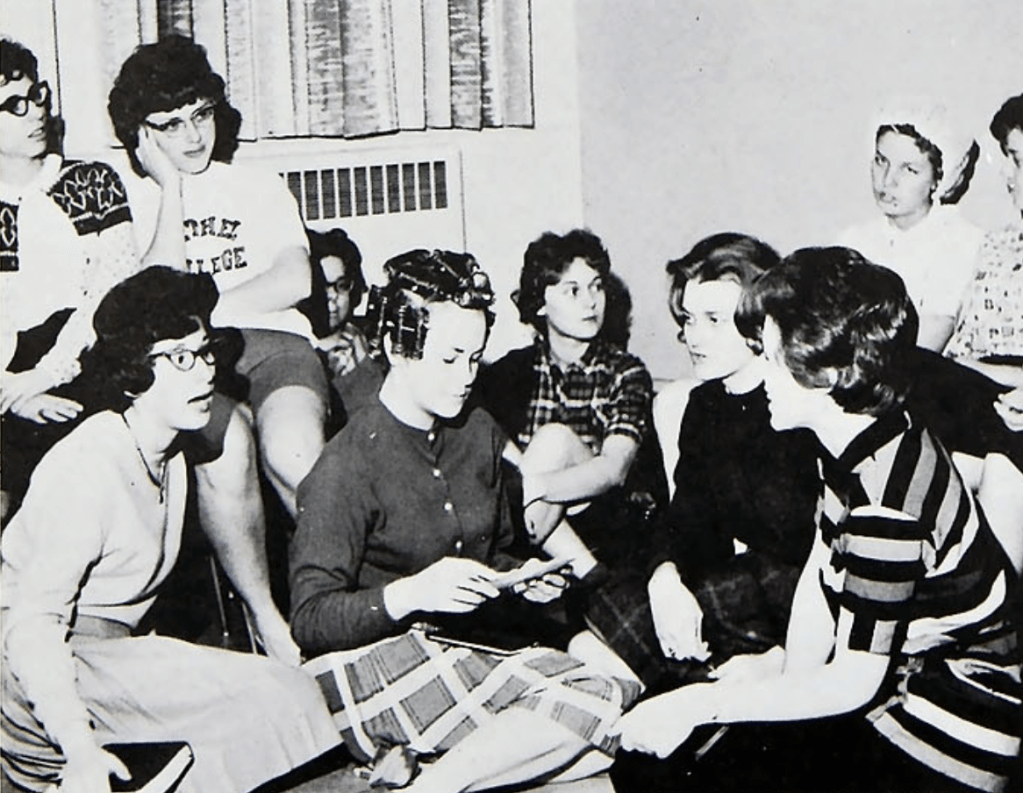
I haven’t yet found anything like an update of this study from the Seventies, with the (Second) Sexual Revolution much further along and Bethel (unlike its former St. Paul neighbor) relocated to the suburbs. But at the end of that decade, some Bethel psychology professors did conduct a different investigation into their student views on another issue relevant to our women’s history project: “sex-role stereotyping,” which troubled those faculty members because “regardless of their unique identities, talents and spiritual gifts, a large portion of American women end up in the same role—homemaker.”
In the November 1978 issue of Bethel College’s faculty journal, Mike Roe, Glenace Edwall, and Carol Kramer wrote up the results of a study conducted one year earlier in their department’s Introduction to Psychology survey course. They analyzed 190 students’ written responses to a class assignment “which required comment on the responsible fulfillment of men’s and women’s professional, marital and parental roles.” Although the professors didn’t specify or suggest any topics for these responses, 94% referred to childrearing, with 72% of students presenting that responsibility “as primarily the mother’s,” and 52% brought up housekeeping (55% indicating it was primarily the wife’s responsibility). 63% described breadwinning as being primarily the husband’s responsibility, though relatively few students (16%) even mentioned that role — prompting the authors to suspect “that a far larger portion of the students were responding from an implicit assumption of the husband as wage earner.”
Indeed, Roe, Edwall, and Kramer were struck how little effort most students made to explain “role assignment… other than a few statements of assumed innate ability predisposing the woman to proper child care.” They found the prevalence of “sex stereotypes” disturbing because such assumptions conflicted both with research emphasizing the developmental importance of fathers in childrearing and with what they took to be Bethel’s religious commitments:
These data are also disturbing in this community in that they suggest students are adopting dominant cultural values rather than considering the Biblical principles of personal relationship, the value of the individual in Christ, and, most directly, the concept of the body composed of a membership possessing diverse and complimentary [sic] gifts. The evangelical community — the Bethel community — should be functioning in its prophetic capacity to break down sex role stereotypes and actively encourage many and unique options to women and men corresponding to their many and unique abilities and gifts.
I can’t tell you anything about Kramer, but for a bit of closing context on the other two authors… Edwall taught in Bethel’s Psychology Department between 1974 and 1987, becoming the first woman to join its full-time faculty in 1977. (Marilyn Starr, then Dean of Women, had earlier taught both Psychology and Physical Education.) As I mentioned in an earlier post, Roe was a self-identified Christian feminist who was one of the first men to serve on the Women’s Concerns Committee, just before moving to Seattle Pacific in 1988.
One goal of this blog is to help involve members of the Bethel community in doing the history of Bethel, so comments are always welcome! Just know that if you leave a comment at the project blog, I’ll take that as expressing your permission to quote it in the project.
 The Women of Bethel