
Thus far, I’ve tended to use this blog to write the first drafts of stories that will likely feature, in some way, in our final project narrative. But once in a while, I come across sources that may not make the final cut, but are undoubtedly interesting. So today I’m starting a new series of shorter posts, each featuring a primary source that I found in Bethel’s archives — or today, in our Digital Library.

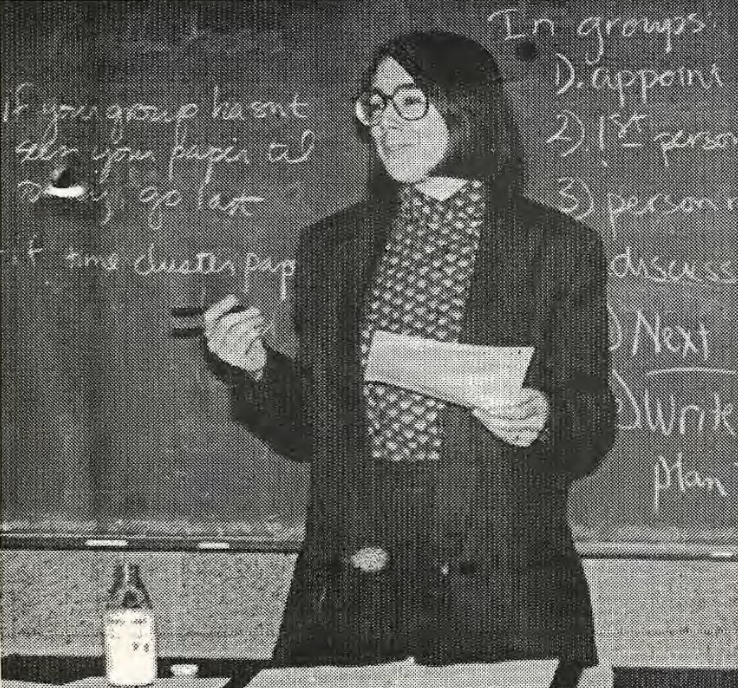
When I first came to Bethel, Mary Ellen Ashcroft found out that I was interested in World War I and invited me talk about that conflict with her class on 20th century literature. Unfortunately, our time at Bethel didn’t overlap for long; in 2005 she moved to Kalamazoo College to serve as its chaplain and teach English. But as I’ve researched the women’s history of Bethel, I’ve learned more about Ashcroft’s earlier years on the College faculty.
In the spring of 1992, for example, she helped organize a series of faculty forums on gender, leading the one on “Gender, Language, and Classroom Discourse.” “Gender issues at Bethel are very powerful, but often times not talked about,” she told the student newspaper. “We felt that by the time students leave Bethel, they should have thought about a whole range of issues relating to gender.”
One such issue was women’s self-image. The year before, she wrote a Clarion op-ed that started with her noticing a poster in a Bethel hallway: “It showed a blonde woman with her head tilted back, and her little hands clenched with childish excitement, who would be singing in chapel. ‘Am I jealous,’ I asked myself, ‘because I wish I were blonde and looked like a fourteen year old?’”
It struck Ashcroft that such a poster would never feature a man in that way — or if it did, that he’d be mocked or pitied. “Although the singer on the poster may be very nice and her singing may be wonderful,” she continued, “I was disturbed because this infantile picture speaks volumes about what is valued in Christian women. To be attractive, a Christian woman must look (and perhaps act?) childish—she needs Mr. Right to rescue her; she must be sort of silly and lighthearted—never an independent thought; she must be slim and cute. These are valued in a young Christian woman, because it is assumed that her highest calling is to marry and depend on a nice Christian man.”
At this point, I’ll quote Ashcroft’s op-ed at some length, so you can follow her unfolding argument more clearly:
I find it depressing that many women who were raised in Christian homes would see this view of women as Christian, not sinful. Perhaps Satan has more trouble selling Christians on individual sins like fornication and drunkenness and brawling, so he concentrates on leading them into distortions about human relationships and values; these warped values become so normal that we hardly notice them.
As I looked at that poster… I thought of Tecla who faced martyrdom rather than getting sucked into the Roman-style marriage where she would become her husband’s possession and never be able to have real freedom to witness for Jesus. I tried to imagine the Apostle Paul writing to women, “And you women, be childish, silly and cute….” I tried to picture a new version of Proverbs 31: “A good woman, who can find? She will always be slim and cute; her giggle will permeate the household; she will never carry on an intelligent conversation; her highest goal in life will be to find and marry Mr. Right.” I also imagined Satan rubbing his hands with glee: how many women who might have had effective ministries and lived for God, are instead trying to look childish and helpless, and believe that “the chief end of woman is to find Mr. Right and make him happy forever”?
She was speaking to issues common in early 1990s America and on its college campuses. (The next section addressed weight loss.) But it’s fascinating to see Ashcroft frame sexism for Christian college students, whom she expected to recognize her allusions not only to the Bible, but to the first article of the Westminster Shorter Catechism (“Man’s chief end is to glorify God, and to enjoy him forever”).
Ashcroft explained that “sin is more than individual acts of fornication, Haagen-Daz binges, or jealousy at a roommate (although these are indeed sins),” but can include worldly “distortions [that] have completely permeated our Christian sub-culture.” She warned Clarion readers that something as seemingly innocuous as a Christian dieting book or a poster in the hallway of a Christian college could warp the image Christian women had of themselves, the expectations they had for their lives: “This distorted view of what is important (whether it’s weight, childishness, or marriageability) is SIN.”
So Ashcroft, an Episcopal priest as well as a writer and teacher, ended the op-ed not just with a call to action, but a call for repentance:
We need to look honestly at ourselves and see what our temptations (those we fall for and those we resist) are telling us about our lives, so that we can rid ourselves of them and find the freedom of being loved by (and living for) God.
One goal of this blog is to help involve members of the Bethel community in doing the history of Bethel, so comments are always welcome! Just know that if you leave a comment at the project blog, I’ll take that as expressing your permission to quote it in the project.
 The Women of Bethel
Hi Chris,
I am going to be speaking about my experiences in the church and how it has shaped me into the feminist I am today in a vlogcast I host with a friend. I love so many quotes in this post. Do I have your permission to state any of them during my vlogcast? I would of course give credit to you and the speaker (as appropriate). If not, no big deal, but as often happens, your words have touched my heart.
Brittany
LikeLiked by 1 person
Of course, Brittany. Best wishes with your project!
LikeLike