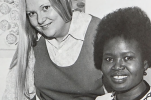

When Bethel College first moved to its new campus by Lake Valentine, hardly anything in its academic catalog suggested that gender was an important subject in the Bethel curriculum. Apart from offering men’s and women’s choirs and sex-segregated versions of selected physical education courses, the Bethel College catalog for 1972 can seem gender-neutral. But given what wasn’t being taught at that point, we might have the same response that the nascent Women’s Concerns Committee articulated fourteen years later: “more attention needs to be given to incorporating work of women into the required male-centered curriculum.”
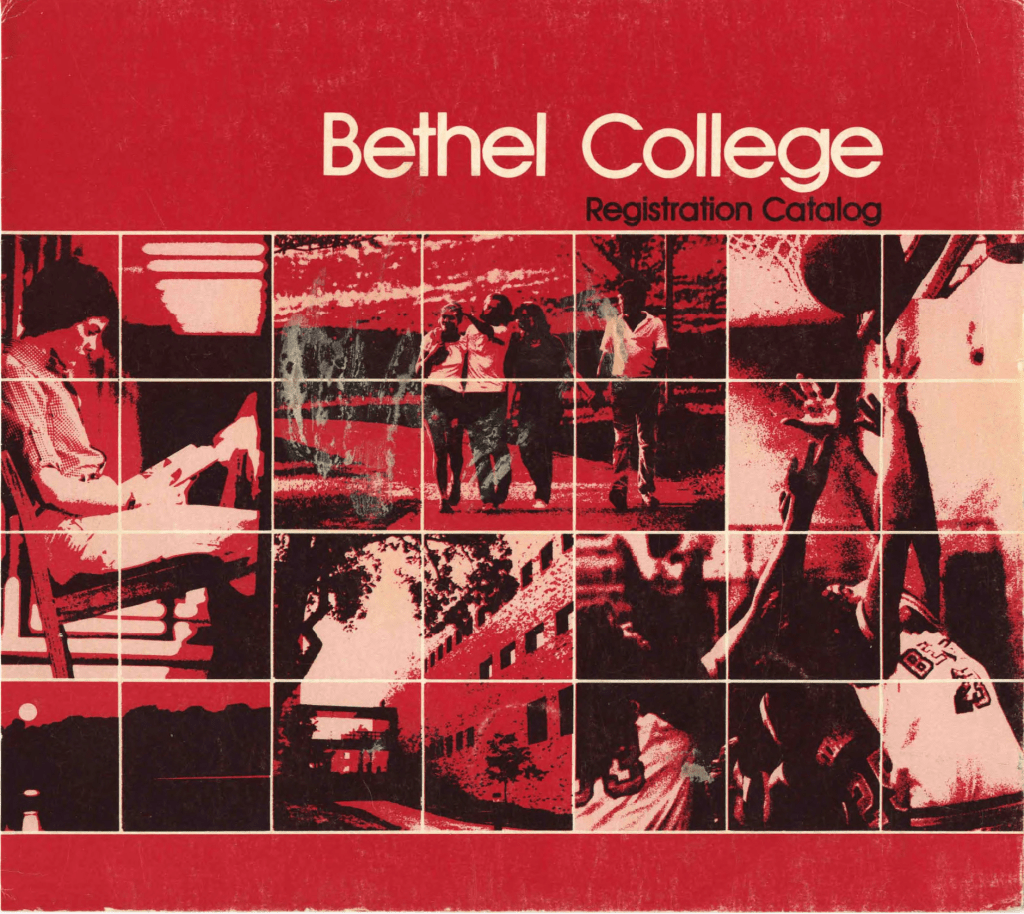
By the time that committee gathered in 1986, the catalog was starting to reflect how at least some Bethel professors and departments were paying greater attention to the study of women. From its founding in 1978, the Social Work department expressly focused students’ attention on the role of women, both in the Social Welfare in America course it shared with the History department (where social reformers like Jane Addams were crucial figures) and in its own capstone seminar on social work practice and policy analysis. Women also show up as a key topic in two courses that debuted in the 1986-87 catalog: a Biblical Studies/History course on 2nd century Christianity (After the Apostles) and an English course called Literature of the Oppressed. In her oral history interview this past summer, Marion Larson remembered joining the English department that year, at a time when faculty were paying more attention to “what authors we’re assigning, what issues we’re looking at in class,” out of the conviction that “it shouldn’t just be dead white guys that we were studying.”
Incorporating women into broader surveys continued over the next five years. By 1987-88, for example, a History course on A New Nation included “changing roles of women and minorities” among other themes for a survey of the United States between the end of the War of 1812 and the start of World War I. As the Eighties turned to the Nineties, Roger Olson’s survey of historical theology may have been named for Church Fathers and Reformers, but its description promised to cover “great men and women of church history,” while upper-level English courses of that era also started to list more women authors in their descriptions — e.g., Emily Dickinson in American Renaissance; Kate Chopin, Sarah Orne Jewett, and Edith Wharton in American Realism and Naturalism; and Virginia Woolf and Gertrude Stein in Dan Taylor’s Modernism course for England Term.
The Eighties also saw a small surge in courses that didn’t just add women to a longer list of topics but made women or gender their central theme.
Initially, most were taught in Bethel’s “J-term” — an intentionally experimental space, at least at its outset, where students would immerse themselves in just one among a selection of courses that “[differed] from those taught in the fall and spring and are offered for one or two years only.” Indeed, many came and went fairly quickly, such as Roles of Men and Women (Social Work, 1982), Women in Today’s Society (General Studies, 1985-1990), Literary and Philosophical Perspectives on Women (English/Philosophy, 1985-1986), Women Writers (English, 1987-1990), Gender and the Brain (Biology, 1988-1992), Communication Analysis: The Gender Factor (Speech-Communication, 1990-1992), and Women in the Bible (BTS, 1990-92). From the mid-Eighties, Leta Frazier taught gender communication both as a stand-alone course and as part of Interpersonal Communication.
Other courses became regular curricular offerings. From its launch, the new Nursing program not only brought many more women into the faculty and student body but included an upper-level course on Nursing Care with Childbearing and Childrearing Families that paid particular attention to the experiences of mothers. Until a recent modification to the general education curriculum, the Biblical and Theological Studies department offered an exegesis course on Female and Male in Biblical Perspective that first appeared in the 1990-91 catalog.
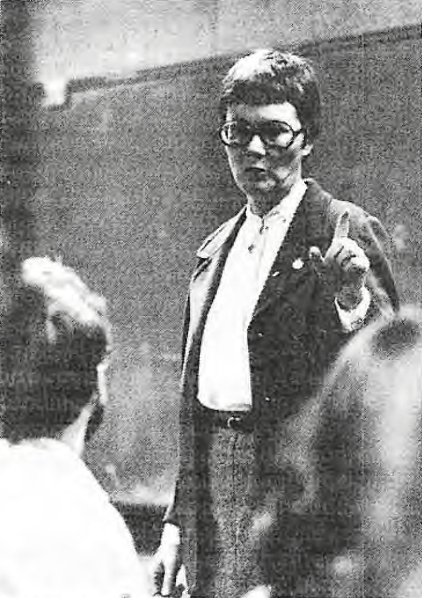
Perhaps the most enduring example of the theme is Women’s Lives, Women’s Choices, an upper-level general education course that psychology professor Kathy Nevins taught from 1989 until her retirement in 2022.

“Female experience is qualitatively different from the male experience,” Nevins wrote in her October 1988 proposal, “yet most academic programs do not acknowledge these differences let alone affirm them as valuable in their own right.” From the start she was particularly concerned to help women students who received “paradoxical messages concerning their roles and value” in a society where “Victimization, abuse, discrimination, high rates of Mental Illness are issues associated with a ‘woman’s place.'” (And to ask, which of these “messages are ‘right’ for Christians?”)

But the course was never limited to women students. Her file on the course in the Bethel archives includes draft guidelines for male students completing a final project exploring a women’s role, such as…
Explain how/when/where you might find yourself in relationship with a woman in this role… Explore the possible impact of the woman’s role on your self-esteem, how you might value, or not value and treat yourself because of this role… Explore the possible impact of this role on your relationship at that future time. How might you value (or not value) and treat this woman? How might she treat you?… Explore how your faith might influence your attitudes and behavior towards the woman in this role? How might your own spiritual growth (and hers) be affected?… Identify how much influence you have in the woman’s choosing, or simply being in, the role you have been exploring… what have you learned about yourself from this project?
Not realizing this, some members of the General Education Committee initially withheld their approval. In her own interview with us over the summer, Nevins recalled assuring the committee chair not only that men could enroll, but that “they need to take it more than the women do.”
One goal of this blog is to help involve members of the Bethel community in doing the history of Bethel, so comments are always welcome! Today I’d particularly welcome recollections about these courses from students who took them or professors who taught them. Just know that if you leave a comment at the project blog, I’ll take that as expressing your permission to quote it in the project.
 The Women of Bethel