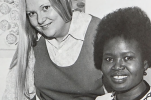
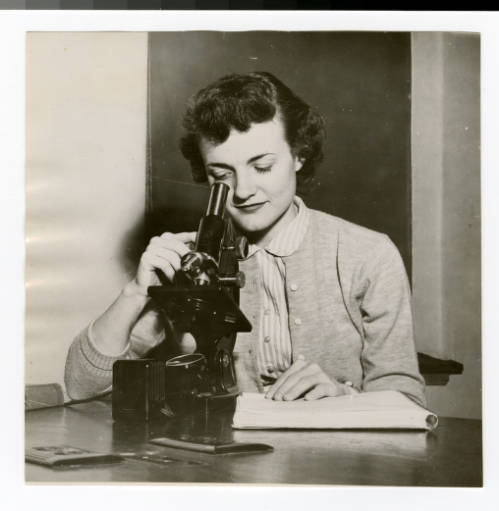
Why am I spending the fall of 2024 researching the women’s history of Bethel University? Here’s how I explained my latest sabbatical project in a post written earlier this year.
When Bethel hired me in 2003 to teach modern European and international history, I certainly didn’t expect to devote so much of my scholarly agenda to the history of an American university I’d never before visited. But as we enter 2024, I find myself in the unlikely position of being the primary living interpreter of my institution’s history.
Building on the good work of predecessors like Adolf and Virgil Olson, Jim and Carole Spickelmier, Stan Anderson, G.W. Carlson, and Diana Magnuson, I’ve undertaken a number of institutional history projects the last fifteen years or so. But as far as I know, this will be the first time any Bethel historian has attempted to tell a version of our university’s story that places women at its center from beginning to end. That is, from Elizabeth Johnson and Anna Nelson, who enrolled at what became Bethel Seminary in 1879-1880 in hopes of serving as home missionaries to fellow Swedish immigrants in Chicago, to the present day, when women not only make up more than 60% of the college student body but fill key roles across our faculty, administration, staff, and board.
Most broadly, that means that I’m attempting what Beth Allison Barr, Allison Brown, Katherine Goodwin Lindgren, and David Whitford recently called “regendering our approach to the history of Christianity” — a history in which “women were neither passive nor silent,” yet continue to be overlooked.
“The women of the past deserve to have their stories told,” they conclude. “It is time for us to tell them.” So most of all, I want to help recover and recount the experiences and perspectives of students, professors, coaches, deans, and others at Bethel who have been absent from most previous Bethel histories, or limited to supporting roles.
To a significant extent, I’ll be able to draw on what’s already held in our archives, including several files that haven’t yet been digitized. But I’m also planning to gear up for the sabbatical by spending part of the summer conducting oral history interviews with women who played key roles in the transitional decades of the 1970s-2000s, when Bethel appointed women to positions they’d never before held, established several new women’s athletic teams, began to prepare more women for pastoral ministry, and became a key site in the debate between complementarians and egalitarians.
Along the way, we’ll see how one Christian university has wrestled with the questions of gender that scholars increasingly recognize as being central to American evangelicalism: Is there a “biblical” definition of femininity? Are women called to and gifted for roles like pastor, preacher, evangelist, missionary, theologian, or biblical scholar? Should women be in positions of leadership over men? And in answering such questions, how has American evangelicalism both reflected and rejected the mores and values of its surrounding culture? I’m sure we’ll see these debates play out in classrooms and in curricula, on athletic fields and in administrative offices, and in the university’s relationship with its denomination.
…most of all, I want to help recover and recount the experiences and perspectives of students, professors, coaches, deans, and others at Bethel who have been absent from most previous Bethel histories, or limited to supporting roles.
So I do hope to generate at least one journal article out of this research. The higher ed setting is distinctive, and I think Bethel’s Baptist and Pietist heritage and Upper Midwestern location may yield a slightly different version of the story than what’s usually been told.
But my primary goal here is to create a digital history project — akin to what Fletcher Warren and I did in 2014-2015, when we marked the 100th anniversary of both World War I and Bethel relocating to St. Paul by telling the story of Bethel as it experienced a century of warfare. We found that format to be far more accessible for the wider Bethel constituency that we wanted to reach, and I think the same will be true for the women’s history project.
While I do think that the women’s history of Bethel is worthy of study for its own sake, I’m also hoping to find a “usable past” in this project: to reinterpret where we’ve been so as to help guide us to where we’re going. Perhaps the results will be illuminating for our leaders, administrators, and trustees. But if nothing else, I trust that I’ll provide faculty like me with some material for teaching. I’ve often used essays from the Bethel at War project to help students in my WWI, WWII, and Cold War classes connect more personally to those histories, and I can imagine doing the same in, say, our sports history class, where Bethel could become a case study for our weeks dedicated to the topics of gender and higher education.
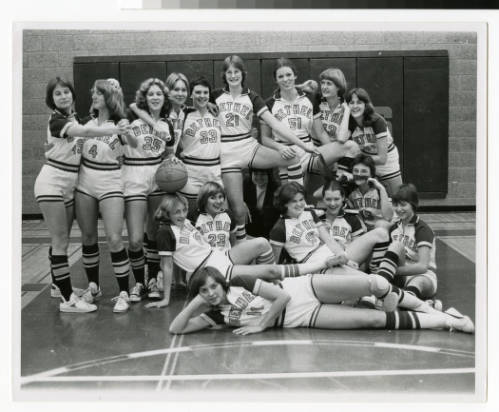
But in addition to any institutional benefits, I also have a lot to gain personally with this project.
As I wrote last summer, getting to take months off from teaching, for a research project of any type, is a significant blessing for any college professor: “Not because we don’t love teaching, but because Bethel wants its faculty to have time to rest from that labor and use our time differently. Much as I love teaching, it wears me down — and it takes too much focus to concentrate on other activities.”
Then while the proposed project lets me extend my existing agenda as an institutional historian, it also lets me address a professional shortcoming. Though I share a department with experts on gender like philosopher Sara Shady and historian AnneMarie Kooistra, that category of analysis was neglected in my graduate training and has remained peripheral to my work in the classroom and archive. Women’s history has never been absent from my teaching and scholarship, but I relish the chance to recenter it for so significant a project as a sabbatical. Halfway through my career, I’m eager to try something different, learn new content, theory, and methods, and bring new insights back into the classroom.
Cross-posted at Substack
One goal of this blog is to help involve members of the Bethel community in doing the history of Bethel, so comments are always welcome! Just know that if you leave a comment at the project blog, I’ll take that as expressing your permission to quote it in the project.


As you uncover the “usable past” in this project, the findings will undoubtedly provide valuable insights for Bethel’s leaders, administrators, and trustees. The impact on Bethel’s students—both current and future—should not be underestimated, as these insights have the potential to significantly empower and inspire them.
LikeLiked by 1 person