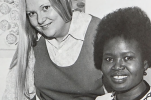
There was nothing unusual about the Apostle Paul being quoted at Bethel, in the 1930s or any other decade. But in this case one student was thundering 1 Corinthians 14:34 and 1 Timothy 2:12 at another: “Let women keep quiet in the churches. I allow no woman to usurp a man’s authority!” For once in her life, Ethel Ruff went away quietly, only to run into the same male student another day and hear him yearn “for the good old monastic days when women were barred from these sacred halls.”1

Ruff had left rural Alberta in 1938 to enroll at Bethel Junior College, where she recalled being “brash enough to make it known that I was aiming for the preaching ministry.” After her encounters with the dismissive classmate, Ruff asked the dean of Bethel Seminary if his school welcomed women. “Don’t let the fellows’ razzing bother you,” Karl Karlson laughed. “I should say [women] are welcome—on the same conditions as the fellows. Bethel knows no double standard.” Increasingly, Ruff found her call to pastoral ministry being affirmed at Bethel. She won a scholarship, led the Missionary Band, and preached a “song sermon” at a 1940 meeting of the Bethel Women’s Association — with future journalism professor Alvera (Johnson) Mickelsen playing violin. When not taking Seminary courses, Ruff served as a Sunday School teacher and traveling evangelist, preaching at churches in the Upper Midwest and Canada.2
After filling a pulpit in Saskatchewan during the Christmas break in 1942, Ethel Ruff asked her pastor at Payne Avenue Baptist Church in St. Paul3 to ordain her. Though an unusual request in that era, Rev. Martin Erikson reported that his “council was united in the feeling that this was of the Lord.”4 Bethel leaders consistently encouraged Ruff to follow her calling: president Henry Wingblade taught her how to baptize by immersion and recalled “how proud” he had been to have a woman pastor during his childhood in Kansas; Karl Karlson preached at her ordination service in June 1943; and former College dean C.E. Carlson introduced her 1957 memoir as exhibiting “the vitality of a wholesome nonconformity.”5 By then editor of the Baptist General Conference (BGC) magazine, The Standard, Erikson not only recommended Ruff’s book, When Saints Go Marching, but hired her to write a regular column. “I am so glad you do not silence her because she is a woman preacher,” responded one appreciative Standard reader in 1959.6

Ethel Ruff’s story can be read as an exception that proves a larger rule, since congregations in Bethel’s denomination are only slightly more likely to ordain or call women to pastoral ministry now than they were in the 1940s. But the reality is more complicated. Ruff was neither the first nor the last woman to preach in Bethel’s denomination. In recent decades, women have grown from a small minority to a slight majority of the Seminary’s student body. And over that same period of time, Bethel faculty have been leaders on both sides of the intra-evangelical debate over women’s ordination, an argument that was anything but academic to the women who became campus pastors and seminary professors at Bethel.
Women in Ministry in Swedish Baptist America: The First Decades
Ruff was the first to be ordained, but women had been going to Bethel Seminary to prepare for ministry since before it was even called Bethel. “In the early years of the school,” wrote father-and-son historians Adolf and Virgil Olson, “the founder made provisions for the education of women missionaries to work in the large cities. Here again Edgren stepped ahead of his times, as he did in nearly every undertaking.”7 John Alexis Edgren didn’t limit his new Swedish Baptist seminary to men when it was first announced; his school enrolled Elizabeth Johnson in 1879, two years before the American Baptist Missionary Training School (also in Chicago) opened its doors to women. In seeking preparation for ministry among fellow immigrants, Johnson was filling a common role for women in the early days of the Baptist General Conference. In the late 1880s, she was one of nine women sent out as home missionaries by the same church that later ordained Ethel Ruff.8 “Whether on the frontier or in the inner city,” explained church historian Janette Hassey, “women’s public ministry was often born of necessity,” as women like Johnson “met the perceived need to evangelize an increasingly secular and expanding American population in desperate need of the gospel.”9

Likewise, as the BGC started to commission foreign missionaries, the first to go was another woman: Minnesota schoolteacher Johanna Anderson, who arrived in Burma in 1888. Nine of the first fifteen Swedish Baptist missionaries sent abroad were women, as was the first Bethel alum to enter the foreign missions field: Olivia Johnson, who headed to the Philippines after graduating from Bethel Academy in 1913.10
Meanwhile, women filled pulpits in late nineteenth and early twentieth century America, as in the case of the Kansas church that Henry Wingblade mentioned to Ethel Ruff. In her analysis of that era’s women preachers — some ordained pastors, others traveling evangelists — Hassey found the phenomenon most common among fundamentalists and evangelicals, whose “women preached, pastored, and taught the Bible at the turn of the century, convinced that their ministry entailed obedience to God’s Word, not rebellious disobedience.”11 In his centenary history of the BGC, Adolf Olson included the story of Amanda Yman, a Swedish evangelist who sparked revivals in Minnesota, Wisconsin, and the Upper Peninsula of Michigan in the late 1880s and early 1890s. “Preaching by women was then a brand new thing among Swedish Baptists,” he added, “hotly disputed by some, and by reason of that made more attractive to others.”12
One Swedish Baptist who disputed the right of women like Yman to preach was Carl Gustaf Lagergren, who succeeded Edgren as Seminary dean in 1889. If ever “women were barred from” the halls of that school, it was under Lagergren, who complained that “the unbiblical preaching by women has caused confusion and hurt the work.”13 According to the biographical records assiduously compiled by the Olsons, no women enrolled at the Seminary under Lagergren until his final year, 1921-1922, when Ingeborg Sjordal (a Swedish teacher at Bethel Academy) and Kansas City-born sisters Amanda and Myrtle Sten took classes there.14 “Nothing should give the suggestion that we were having a matrimonial bureau instead of a mission school,” Lagergren warned Bethel president G. Arvid Hagstrom after the Seminary settled in St. Paul. “Under any circumstances the feminine influence would be a hindrance to our brethren in their studies and work. The influence has already been noticeable, although it has come from the academy.”15
But with Lagergren’s retirement in 1922, Hagstrom launched a two-year Bible and Missionary Training School (BMTS) that brought more women back into the Seminary’s student body. Two years later, University of Chicago graduate Esther Sabel was hired to run that program, making her the first woman to hold a full-time faculty position at Bethel Seminary. Unable to enter the foreign missions field because of poor health, Sabel had dedicated herself to religious education — but also preached in many Twin Cities churches during her years at Bethel. Sabel “beat any man I ever heard preach,” she recalled one Baptist exclaiming after he heard her sermon on the Holy Spirit.16
Even after the BMTS became a one-year Christian worker course in the Junior College in 1935, a handful of women continued to pursue seminary studies at Bethel. In her first yearbook photo as a seminarian (above), Ruff is one of five women — surrounded by three times as many men. However, Ruff earned a bachelor’s of divinity, not the graduate degree that became the more common pastoral credential after World War II. It would be another three decades before Bethel Seminary awarded its first M.Div. to a woman.
Expanding Opportunities, Deepening Debates: Through the 1970s
From 1952 to 1961, the Baptist General Conference grew by 50%, surging to more than 75,000 members. Yet church history professor Marvin Anderson calculated that Bethel Seminary enrollment increased by less than 9% in the same time period. In a 1962 memo he urged Bethel president Carl Lundquist to take advantage of Bethel’s impending move to a larger campus in Arden Hills by doubling or even tripling the size of the Seminary student body.17

By the time the College joined the Seminary on the new campus in 1972, enrollment at the latter had cleared 200 — but just 3% of those students were women.18 There was a women’s group at the Seminary, but it sought to “provide mutual encouragement and Christian fellowship for Seminary Student Wives and their husbands” and hosted monthly meetings on topics like “Communication in Family Relations,” “Gracious Entertaining On A Limited Budget,” and “Tips on Hosting Bible Studies.” A “Mrs. Mickelsen” led that last session — College journalism professor Alvera Mickelsen, that is, whose husband taught at the Seminary.19
When The Standard reminded readers, “Don’t Forget the Women,” in 1974, it included photos of seminary wives, but also profiled several women who had just started master’s programs at Bethel.20 One of them, Pamela Johnson (later Scalise), had grown up at the same church that ordained Ethel Ruff. Eager to study theology at her “family school,” she served as a teaching assistant for the men on the Old Testament faculty, who encouraged her to pursue her doctorate in that field at Yale and become a seminary professor herself. “Bethel Seminary was overwhelmingly male, yet I felt at home there,” she recalled. “No one at Bethel – faculty, students, or staff – ever opposed me to my face for being in seminary. They knew that I was not headed toward the pastorate or any other congregational ministry.”21

Women who discerned a more pastoral calling tended to have a more difficult experience. More of those seminarians sought an ordination pathway “as their responsibilities and ministry became more pastoral and… and leadership oriented,” said Barb Martin, who worked in the Seminary’s field education and placement office before becoming the College dean of women in 1985. “But I think there were just a lot of skepticism on the part of the churches.” Even their home congregations often “weren’t really supportive… ‘I don’t know about this woman in ministry or a woman going to seminary.'”22
In 1976 Carol Shimmin (later Nordstrom) became the first woman to earn a Bethel M.Div. — and two years later, one of the first women ordained by the Evangelical Covenant Church. In its 1974 profile, The Standard had emphasized that Shimmin “cannot imagine herself in a pulpit ministry.”23 Indeed, she initially entered the M.Div. track in order to fulfill a potential requirement for doctoral study, but came to enjoy preaching. Told in that class that her skirt and blazer looked “too masculine,” she learned that male students preferred to see her wear a dress so that “they could look at me as a ‘woman’ then and not have to hear what I was saying!”24 While Shimmin’s classmate Susan Verunac reassured readers of The Standard that “the professors and most of the guys have made special attempts to make me feel wanted,” her own experience studying homiletics made her wrestle with the gendered language of the Seminary’s slogan at the time:
…”‘the man of God communicating the Word of God.” Here in preaching class that slogan was emphasized again. How was I, a woman, to fit into this whole area of communicating the Word of God? Must I be squeezed into the traditional mold and try to find fulfillment in Sunday school classes and Women’s Missionary Society, or could I actually teach and preach?… Is there a church that would welcome a woman preacher? If so, would I go, knowing how so many Christians feel about this matter? And yet, am I not allowed to pursue training in this area?25
In 1975 the authors of Bethel Seminary’s self-study for the Association of Theological Schools didn’t comment directly on the school’s growing number of women students. But they did note that the Seminary Wives fellowship group had rebranded as Women Alive (out of a “desire to serve all women on campus”), and they adopted more inclusive alternatives to the masculine terms used in the study’s first draft: e.g., “Each student must discover himself or herself… While the Seminary provides training in skills, it also places a high premium on preparing the man or woman behind the skills.”26
The Seminary didn’t hire its second female professor until Jeannette Bakke joined the faculty in 1978, twenty years after Esther Sabel’s retirement. But men on that faculty were already pushing the institution and its denomination to affirm women in pastoral ministry. In a 1975 letter to The Standard, Marvin Anderson recalled “the special mystique” of Ethel Ruff, who had been his father’s associate pastor at Ballard Baptist Church in Seattle. He hadn’t specifically urged recruitment of women students in his 1962 memo on Seminary expansion, but in the year that enrollment cleared his target of 300, Anderson celebrated their presence in the student body: “God has ordained women as well as men to be agents of love in a world of hate, to respond to each other as friend, not as foe; to acknowledge in humility that God calls male and female to do His work.”27 Two years later, it was Seminary professor Berkeley Mickelsen who offered the most definitive Yes when the College’s student newspaper, The Clarion, asked six (male) professors, “Should women be ordained pastors of churches?” The New Testament scholar described fixed gender roles as a result of sin, with God’s intention of “complete partnership, interchangeable roles in terms of ruling, subduing, and controlling the world” being restored through the Gospel. “God chooses us,” he concluded. “How can we question God’s choice if it is a female? Gifted people in the ministry will help the whole church.”28
It was the College faculty on that Clarion panel who either qualified their support for women’s ordination or opposed it outright. The strongest No voices came from two young scholars who are better known for the post-Bethel phases of their careers. “The question here is whether we are going to obey the Bible or conform to the pressures of modern society,” responded theologian Wayne Grudem, who had been ordained at a BGC church in Eau Claire, Wisconsin. “Of course women pastors have been used and blessed by God in the past. But Scripture, not experience, must be our standard. If Scripture is our standard, then we must say that God has blessed women pastors in spite of their disobedience of 1 Tim. 2:12, and not because of it.” Three years before he left Bethel to pastor Bethlehem Baptist Church in Minneapolis, Bible professor John Piper acknowledged as “a complex hermeneutical question whether Paul’s view [in that verse] was so culturally conditioned that it is not valid today.” But he concluded that that apostle “had a profound insight into the God-given distinctives of male and female. And I think his view which calls for male headship in the home and male authority in the church is a divinely inspired means of preserving the health of the church and the unique glory of man and woman.”29

As the debate over women’s ordination intensified, Bethel’s denomination chose not to take a stance. “Pastoral service by ordained women in the Baptist General Conference has been a quiet, almost unobserved phenomenon for decades, and no noticeable protest has been registered, at least in recent years,” conceded Standard editor Donald Anderson in February 1980. But while he noted the growing number of “women enrolled in the pastors degree course at Bethel Seminary,” Anderson also affirmed what he saw as strong arguments against women’s ordination. In the end, he reported that the BGC’s executive committee had withdrawn a resolution on the issue from the agenda of that summer’s annual meeting in Erie, Pennsylvania, leaving ordination “a necessary function of the local church'” rather than a denominational decision.30 While The Standard published letters on both sides of the debate, most of the mail favored women’s ordination. For example, a retired pastor who had graduated from Bethel Seminary in 1931 did not believe that “a male oriented (and/or dominated) culture… should continue as such, in the light of more careful reading of the Scriptures.”31 A woman from Stanchfield, MN — where Amanda Yman had once led a revival — called the BGC leadership’s decision “a clear case of burying the head in sand at a time when open discussion is so needed…. I can only wonder how long the waste of women seminary graduates will be condoned under the subterfuge of ‘God’s will/taboo’ language.”32 Nevertheless, five years later the BGC executive board confirmed that ordination would remain a local decision, in a denomination where a majority of churches refused to call women as pastors even as a minority did just that.
“Since Conference Baptists hold varying interpretations of the Scriptures as they apply to women in ministry, the issue of the ordination of women must not be permitted to become divisive to the fellowship.”33
BGC statement on women’s ordination, March 1985
New Pioneers: The 1980s to the Present
In the meantime, one alumna of Bethel Seminary made history with her new job at Bethel College. “Sherry and I work together as equals,” campus pastor Bob Duffet told the student newspaper in October 1985, as Sherry (Bunge) Mortenson started work directing a new undergraduate discipleship program and preaching monthly (then more often) in chapel.34 Hired out of seminary by new president George Brushaber, Mortenson wasn’t given the title of associate campus pastor until 1991, but she told Clarion editor Julianne Jackson that “I knew when I came here that I was functioning as a servant, a leader, a shepherd, a counselor, a pastor.”35 More recently, Mortenson recalled recognizing “that I was a pioneer. I knew that I was the first woman in many of these settings, which adds an element of pressure and expectation. Somebody else could, you know, have a C sermon and that’s fine. I always felt that I not only was representing myself, but I was making it a challenge for other women.”36 Mortenson’s ministry at Bethel, which continued until 2007, made “a big difference,” according to former College dean Deb Sullivan-Trainor, since “in a denomination that has various levels of conservatism in it, for there to be a woman pastor was actually huge.”37
Meanwhile, women like Jeannine Brown continued to enroll at Bethel Seminary, where faculty member Bob Stein (a No voice in the 1977 Clarion forum on women’s ordination38) was “an amazing mentor” to her, giving Brown chances to teach Greek and encouraging her to pursue her doctorate. She started teaching hermeneutics at the Seminary while still in graduate school, then in 2000 became the second woman after Esther Sabel to teach Bible as a full-time Seminary faculty member.39 At one point a member of nine different faculty committees and then the Seminary’s interim dean in 2011-12, Brown remembered “navigating what might be the plusses of being a woman in the academy with the very real questions inside of me about my own inadequacies—do I get to be at the table in certain instances not because of my competency but because of my gender?”40
But women seeking pastoral calls continued to run into obstacles. Terri Hansen enrolled at Bethel Seminary in 1987, inspired by Penny Zettler, a Seminary graduate whose preaching at Central Baptist Church in St. Paul left her with the “feeling of finally being represented as women and hearing a woman’s voice from the pulpit.” Hansen studied Greek with Jeannine Brown and switched from Christian education to the M.Div. track with the encouragement of Jeannette Bakke. While she appreciated how staff member Beverly Brooks went out of her way to support women students “in their voyage into the man’s world of pastoring,” Hansen remembered that the man in charge of field education and placement seemed to see her husband “as better suited for ministry than me – which may be very true, but I found it confusing and somewhat discouraging.”41 (Another woman student from that era described the same official as “totally non-affirming… I felt just very subtly put down every time I went to that office.”42) After graduating in 1995, Hansen found an associate pastor’s position back at Central Baptist, one of the few local BGC congregations that strongly affirmed women’s ordination.
Altogether, the women’s share of Seminary enrollment neared 20% by 1993-1994, the first year to see a woman elected president of the Seminary student senate.43 Interviewed by College communication professors Leta and Phil Frazier that winter, one female seminarian complained that male professors and peers “did not affirm ordination for women and made it very, very clear that it shouldn’t be an option for women,” while another reported being “totally and beautifully accepted as an equal before the Lord with all the people in the class.” Overall, the Fraziers found “an acute awareness that it is significantly different to be a female student at Bethel Seminary as opposed to being a male,” a difference made clear by everything from the shortage of women’s voices in chapel and on reading lists to the lack of women’s bathrooms in the academic building. Most importantly for many in the Fraziers’ focus group, the only woman on the Seminary’s full-time faculty was about to lose her position teaching Christian education. “Whatever the intention for removing Jeannette Bakke from the faculty roster,” concluded the Fraziers, “the interpretation is that the act is a decision against women students, in that it removed a unique part of their support system.”44
The Seminary’s new provost, Leland Eliason, began to rectify that problem the following year, hiring College alumna Carla Dahl to develop and lead a new program in Marriage and Family Therapy. By 2000, the year Jeannine Brown and Denise Muir Kjesbo joined Dahl on the Seminary faculty, the 55 female MFT students would help push the women’s share of the Seminary student body over 30% for the first time.45 But Dahl’s appointment was almost undone before it even started.
Dahl remembered “a really expansive spirit at the Seminary, especially around gender,” from her time on staff there in the late 1970s, but she sensed that “a much more conservative and more overtly complementarian spirit had set in” by the time she joined the faculty. While Dahl had started her new job in May 1995, the hire had to be approved at that summer’s meeting of the BGC. John Piper led a movement to block Dahl’s appointment. “The vote was a tiny, tiny margin,” she recalled later. “And that was shocking to think I could lose my job in six weeks because I’m a woman.”46
As Bethel entered the 21st century, the first woman — and first African American — to serve as Bethel’s lead campus pastor also experienced pushback from complementarian members of the Bethel community and the BGC, which had begun to do business as Converge. Hired by new president Jay Barnes in 2008 as dean of campus ministry, Laurel Bunker found that “there were parts of Converge that did not want a female in the role, did not want a Black female in the role, and I felt that very swiftly at times, particularly toward the end of my time at Bethel” in 2021. While she recalled that most “colleagues were always gracious,” some students, parents, and pastors represented the “segment of the body of Christ that is very complementarian and for whom my presence was almost heretical, and they let me know it in no uncertain terms.” Interviewed in 2024, Bunker could imagine Bethel naming its first woman president in the foreseeable future, but she didn’t “think we’ll ever see the chaplain or the campus pastor being a woman in the next ten years, until there is a determination within Converge that women have a place and a right to be pastors.”47
The year that Bunker started at Bethel, the Seminary catalog acknowledged that “differences of opinion… regarding the relative roles of men and women” exist on its faculty. But it affirmed that “the Spirit of God is conferred upon men and women alike” — with the Bible making “no restrictions of gender regarding recipients” of spiritual gifts — and that “there are both women and men who sense a divine calling to professional ministry.” While the ordination decision was still up to the local church, no one was “required to justify his or her presence in the seminary in terms of race, gender, or age.”48 Even Dahl, who found her experience complicated by Bethel’s “shared affirmation of both egalitarian and complementarian perspectives” and left for Luther Seminary in 2011, “generally felt pretty supported and pretty respected” — save for the student who “turned his back during class when I was teaching.”49 In more recent years, egalitarian perspectives have come to predominate on the Seminary faculty.50 Indeed, its primary preaching instructor as of the time of writing is College and Seminary alumna Steph Williams O’Brien, who jokes that Sherry Mortenson “kind of tricked me into preaching the first time I preached.”51
Lead pastor of Mill City Church in Minneapolis, O’Brien is one of the very few women filling such an office at churches in Bethel’s region of Converge. While women became the majority of the Seminary student body in 2022-2352, those seeking preaching and leadership roles typically have had to take calls in other denominations. 2024 graduate Terri Russell, who serves alongside fellow Bethel alumna Alice Johnson on the pastoral staff of Salem Covenant Church in nearby New Brighton, had more male than female classmates in her M.Div. courses, but she “did not witness debates about women entering pastoral ministry.” Deeply grateful for the mentorship of faculty like DesAnne Hippe and Alison Lo, Russell also fondly recalled an early course with church historian Jim Smith, whose ability to “[weave] in the told and untold stories of how women have faithfully served as God’s people… was freeing and inspiring. I will be forever grateful to his teaching, his heart, and his leadership and for what I learned in that course that silenced the noise and questioning around gender and call within my mind.”53
Introduction | Debating Gender | Women in Ministry | Policies and Persons
Women and Sports | Conclusion
NOTES
- Ethel Ruff, When Saints Go Marching: The Memoirs of a Baptist Evangelist (Exposition Press, 1957), 47. ↩︎
- Ruff, When Saints Go Marching, 47-48, emphasis original; Minutes of Bethel Women’s Association, January 18, 1940, Women’s Dormitory Council Collection, Box 2, The History Center: Archives of Bethel University and Converge (hereafter HC). ↩︎
- Born on the East Side of St. Paul as First Swedish Baptist Church in 1873, Ruff’s congregation had briefly hosted John Alexis Edgren’s seminary in 1884-85. It moved to Payne Avenue in 1899, then relocated to the suburb of Maplewood in 1963. It is now a campus of Eagle Brook Church, a Converge megachurch with close ties to Bethel. ↩︎
- Quoted in Carol Shimmin, “Pray and Praise and Peg Away,” The [BGC] Standard, May 1, 1974, 18. ↩︎
- Ruff, When Saints Go Marching, 16, 57, 74. ↩︎
- Martin Erikson, review of Ethel Ruff, When Saints Go Marching, The Standard, January 13, 1958, 19; unsigned letter to the editor, The Standard, August 10, 1959, 3-4. ↩︎
- Adolf Olson and Virgil A. Olson, Seventy-Five Years: A History of Bethel Theological Seminary, 1871-1946 (Conference Press, 1946), 10-11, 21. ↩︎
- Adolf Olson, A Centenary History, As Related to the Baptist General Conference of America: “A Century of God’s Grace,” 1852-1952 (Baptist Conference Press, 1952), 194. See also Diana Magnuson, “Swedish Baptist Women in America, 1850-1914: the ‘High Calling’ of Serving Christ in the Life of the Church,” The Baptist Pietist Clarion, March 2009, 1, 15-20. Note that the Baptist General Conference was known as the Swedish Baptist General Conference until 1945; I’ll simply refer to it as the BGC to reduce confusion. ↩︎
- Janette Hassey, No Time for Silence: Evangelical Women in Public Ministry Around the Turn of the Century (Academie Books/Zondervan, 1986), 125. ↩︎
- Olson, A Centenary History, 517-18, 527. “For nearly sixty years, BGC missionaries served through other agencies, primarily the American Baptist Foreign Mission Society. It wasn’t until the end of World War II that the BGC “Advance” included the creation of its own foreign missions program. “It is no exaggeration,” said Virgil Olson in 1979, when he was heading the BGC Board of World Missions, “to state that Christian missions during the past two centuries cannot be understood without taking into account the exploits of brave, capable, spiritual women with vision who pioneered in evangelism, education, medicine, social ministries in nearly every nation in the third world.” Yet his survey of women in the contemporary missions field revealed “a subtle, unconscious bypassing of women, especially single women”; Virgil A. Olson, “Understanding Women’s Role in Mission Today,” paper presented at the annual conference of the Evangelical Foreign Mission Association, March 6, 1979, Virgil Olson Papers, Box 1, HC. ↩︎
- Hassey, No Time for Silence, 128. See also Susan Hill Lindley, “You Have Stept out of Your Place”: A History of Women and Religion in America (Westminster John Knox, 1996), ch. 10. ↩︎
- Olson, A Centenary History, 110, 217, 297. ↩︎
- Quoted in G. William Carlson and Diana L. Magnuson, Persevere, Läsare, Clarion: Celebrating Bethel’s 125th Anniversary (Bethel College and Seminary, 1997), 23. ↩︎
- The student biographies for the Lagergren years appear in Olson and Olson, Seventy-Five Years, 103-168. ↩︎
- Quoted in Carlson and Magnuson, Persevere, Läsare, Clarion, 33. ↩︎
- Quoted in Hassey, No Time for Silence, 58-60. ↩︎
- Marvin Walter Anderson, “A Growing Ministry for Growing Ministers” (1962), Carl H. Lundquist Papers, Box 1, HC. ↩︎
- October 1972 enrollment report, Bethel Theological Seminary Collection, Box 8, HC. ↩︎
- Bethel Seminary Wives, 1972-1973 membership roster, Bethel Theological Seminary Collection, Box 7, HC. For a recent historical treatment of the role of pastor’s wives in American evangelicalism, see Beth Allison Barr, Becoming the Pastor’s Wife: How Marriage Replaced Ordination as a Woman’s Path to Ministry (Brazos Press, 2025). ↩︎
- “Don’t Forget the Women,” The Standard, March 1, 1974, 18-19. ↩︎
- Pamela Johnson Scalise, email interview with author, February 27, 2025. Note that all email and oral history interviews from 2024-25 are quoted by permission of the interviewees. ↩︎
- Barb Martin, oral history interview with Christopher Gehrz and Ellie Heebsh, August 15, 2024, Women of Bethel Oral History Collection, Box 1, HC. ↩︎
- “Don’t Forget the Women,” 18. ↩︎
- Quoted in Sharon Cairns Mann, “The Ordinands: Sherron Hughes-Tremper and Carol Shimmin Nordstrom,” in The Unfolding Mystery of “Yes”: Women Who Were Forces for Change, ed. Mary Lou Sather (Women’s History Commission, Evangelical Covenant Church, 2007), 78. ↩︎
- Susan Verunac, “The Preacher and
HisHer Pulpit,” The Standard, October 15, 1975, 16. ↩︎ - Bethel Seminary self-study, May 1, 1975, 16-18, 71 — in Bethel Theological Seminary Collection, Box 32, HC; emphasis mine. ↩︎
- Marvin W. Anderson, letter to the editor, The Standard, December 1, 1975, 20; October 1975 enrollment report, Bethel Theological Seminary Collection, Box 8, HC. ↩︎
- The Clarion, December 9, 1977, 6-7. ↩︎
- From November 1983 through May 1984, The Standard published a series pairing Piper’s complementarian perspective on issues with the egalitarian views of Alvera and Berkeley Mickelsen. ↩︎
- “Women’s Ordination: Not Yet? Or Ever?”, The Standard, February 1980, 35. ↩︎
- Edwin E. Brandt, letter to the editor, The Standard, June 1980, 34. ↩︎
- Janice Usher, letter to the editor, The Standard, April 1980, 49. ↩︎
- That statement (approved March 26, 1985) seems to have headed off a January 1985 attempt by Illinois pastors to have Bethel hire only new faculty who adhered to what they called a “moderate” position: affirming both that women received all spiritual gifts and that “the creational pattern of male headship requires that women should not exercise ultimate pastoral authority over the church”; see The Standard Collection, Box 4, HC. ↩︎
- The Clarion, October 4, 1985, 1. ↩︎
- The Clarion, December 2, 1991, 1 ↩︎
- Sherry Bunge Mortenson, oral history interview with Christopher Gehrz and Ellie Heebsh, August 16, 2024, Women of Bethel Oral History Collection, Box 1, HC. ↩︎
- Deb Sullivan-Trainor, oral history interview with Christopher Gehrz and Ellie Heebsh, July 9, 2024, Women of Bethel Oral History Collection, Box 1, HC. ↩︎
- See also Robert H. Stein, “‘Women Are Not Allowed to Speak,'” The Standard, November 1987, 36-37 — run in tandem with an egalitarian reflection by College linguistics professor Donald Larson. ↩︎
- Jeannine Brown, oral history interview with Christopher Gehrz and Ellie Heebsh, July 19, 2024, Women of Bethel Oral History Collection, Box 1, HC. ↩︎
- Jeannine Brown, “Gender, the Theological Academy, and Leadership,” reflection presented at the Association of Theological Schools Middler Female Faculty Conference, March 2012; shared by email with author. ↩︎
- Terri Hansen, email interview with author, October 9, 2024. ↩︎
- Quoted in Leta J. Frazier and Philip H. Frazier, “A Report Prepared for the Marketing Team, Bethel Seminary,” March 8, 1994, 16 — in Bethel Reports Collection, Box 8, HC ↩︎
- Fall 1993 enrollment report, Bethel Theological Seminary Collection, Box 8, HC; The Clarion, November 19, 1993, 4. ↩︎
- Frazier and Frazier report (1994), 8-9, 10, 12, 30. Bakke’s position was eliminated as part of the “Seminary A.D. 2001” plan, which began to turn over instruction in fields like Christian education to “ministry practitioners.” That plan also acknowledged as an opportunity and challenge for Bethel that “increased numbers of women are sensing a call to some form of ministry and are turning to the seminary for guidance and nurture”; communiqué by George Brushaber and Fred Prinzing, November 5, 1992, Carole Cragg Papers, Box 1, HC. ↩︎
- Fall 2000 enrollment report, Bethel Theological Seminary Collection, Box 8, HC. ↩︎
- Carla Dahl, oral history interview with Christopher Gehrz and Ellie Heebsh, June 28, 2024, Women of Bethel Oral History Collection, Box 1, HC. Piper’s speech at the 1995 BGC annual meeting doesn’t seem to have been recorded, but he has articulated his argument elsewhere; John Piper, “Is There a Place for Female Professors at Seminary?“, Ask Pastor John podcast, January 22, 2018. ↩︎
- Laurel Bunker, oral history interview with Christopher Gehrz and Ellie Heebsh, June 27, 2024, Women of Bethel Oral History Collection, Box 1, HC. College/Seminary alumnae Caitlyn Stenerson and Steph Williams O’Brien led chapel in the first years after Bunker left Bethel, and the campus ministry team as of Fall 2025 includes discipleship pastor Sara Richards, under new lead campus pastor Nick Cocalis. ↩︎
- Bethel Seminary, 2008-09 Catalog, 11. ↩︎
- Dahl oral history. She returned to Bethel briefly to teach in the Graduate School’s EdD program, then retired from Luther Seminary in 2021. ↩︎
- Brown oral history. Of course, as sociologist Lisa Weaver Swartz found in her examination of Asbury Theological Seminary, egalitarian evangelical institutions can struggle “to consistently practice egalitarianism in real life,” if women “find themselves constrained culturally and structurally by the same genderblind egalitarian framework that opens the doors of institutional authority to them”; Lisa Weaver Swartz, Stained Glass Ceilings: How Evangelicals Do Gender and Practice Power (Rutgers University Press, 2023), 15. ↩︎
- Stephanie Williams O’Brien, oral history interview with Christopher Gehrz and Ellie Heebsh, July 16, 2024, Women of Bethel Oral History Collection, Box 1, HC. ↩︎
- Bethel Office of Institutional Data and Research, “Bethel University Gender Distribution Over Time by School,” accessed June 11, 2025. ↩︎
- Terri Russell, email interview with author, January 10, 2025. ↩︎
 The Women of Bethel