Origins and Early Days | Snelling Avenue | Arden Hills
As a supplement to the longer thematic essays, this three-part timeline provides an overview of the women’s history of Bethel, continuing here with the development of a college that outgrows its urban campus after World War II. For additional context, you’ll also find some moments from the broader history of women in the United States in italics.
Snelling Avenue
1914
The Seminary returns to St. Paul, Minnesota, merging with Bethel Academy on a campus across Snelling Avenue from the Minnesota Fairgrounds.

1916
Margreta Olson Bodien, widow of early Swedish Baptist leader Olof Bodien, founds the Bethel Women’s Federation. She will later become the namesake for a women’s dormitory that’s built as World War II begins.
1920
The 19th Amendment to the U.S. Constitution is ratified, granting women nationwide the right to vote.
“Nothing should give the suggestion that we were having a matrimonial bureau instead of a mission school. Under any circumstances the feminine influence would be a hindrance to our brethren in their studies and work.”
Carl Gustaf Lagergren
1922
Over the objections of outgoing Seminary dean C.G. Lagergren, Bethel adds a Bible and Missionary Training School. That program prepares mostly women students for service as foreign and home missionaries, Sunday School and VBS workers, and other non-ordained ministry roles.

1923
Republican legislators Charles Curtis and Daniel Read Anthony Jr. (nephew of suffragist Susan B. Anthony) first propose an Equal Rights Amendment to the U.S. Constitution.
1931
Bethel founds a coeducational Junior College. The Academy closes in 1936, following years of declining enrollment.
1933
Frances Perkins joins the cabinet of new president Franklin D. Roosevelt, the first American woman to hold such a post. As Secretary of Labor, Perkins plays a key role in the creation of Social Security.
1937
After adding Dean of Women to her faculty role, German professor Effie Nelson organizes the Bethel Women’s Association, which hosts Commencement Teas and other social events, sponsors a “Big and Little Sister” mentoring program for new students, and gives its members chances to lead worship at its monthly meetings.

1943
Bethel Seminary graduate Ethel Ruff becomes the first woman ordained as a pastor in the Swedish Baptist General Conference, with Seminary dean Karl J. Karlson preaching at her ordination service. While Ruff’s ordination is unprecedented, Payne Avenue Baptist pastor Martin Erikson reports that the leadership of his St. Paul congregation “was united in the feeling that this was of the Lord.”
Just before Christmas, former Seminary student Signe Erickson is killed by Japanese occupation troops in the Philippines, one of the ten Baptist missionaries known collectively as the “Hopevale Martyrs.”
1947
Bethel College launches its four-year program. Thanks in part to an influx of military veterans utilizing their G.I. Bill educational benefits, the College student population remains majority-male until the mid-1960s.
1948
“Nikolina’s Dag” debuts: a November social that soon grew into Bethel’s alternative to Sadie Hawkins’ Day — an annual event on many American college campuses in the 1940s, with women asking out men instead of vice-versa.

1954
“Could God really use me in this place?”, Nancy Lundquist remembered asking herself, as her pastor husband, Carl, returned to his alma mater as Bethel’s president. Enrollment doubles twice during the Lundquists’ twenty-eight years in leadership, and Nancy will later celebrate “that God would give us such a strategic age group in which to serve Him…. During these crucial years, students are making decisions that will affect their whole lives—decisions such as depth of commitment to the Lord, choice of a marriage partner, life work and lifestyle.”
“I will miss you more than any other one faculty member will miss you because we have fought together for women’s rights on the campus for the greatest number of years.”
Letter from Effie Nelson to Esther Sabel, 1958
1958
The same year that long-serving Bible professor Esther Sabel retires, the English and Speech Department hires Jeannine Bohlmeyer, who will become a leading feminist voice during her thirty years on the College faculty.

1961
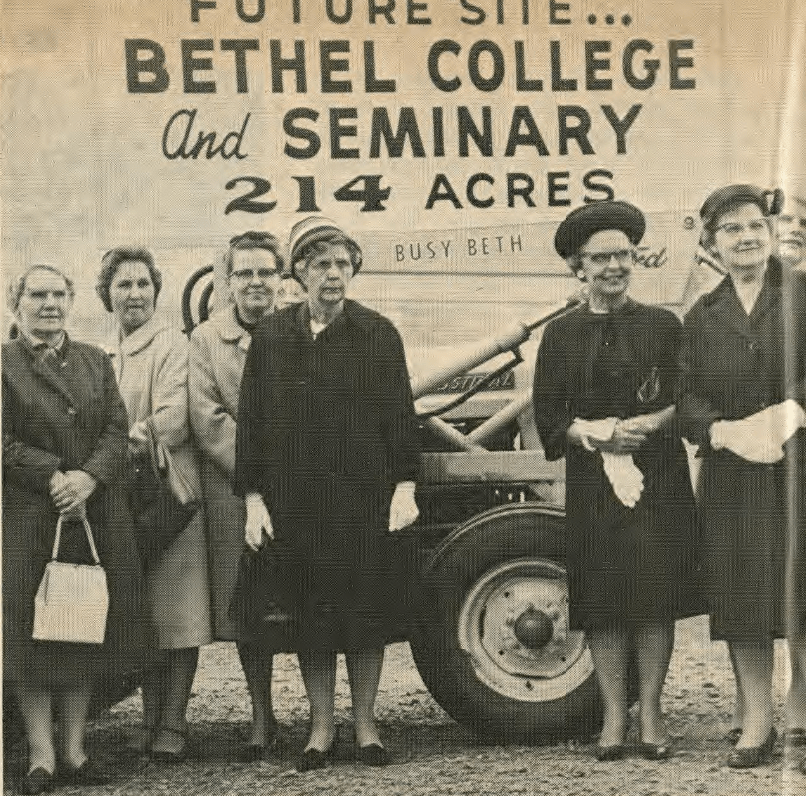
With growing enrollment stretching the capacity of its urban campus, Bethel acquires over 200 acres of land from the Du Pont Company, next to Lake Valentine in the suburb of Arden Hills.
Long-range planning consultants encourage President Lundquist to launch additional professional programs in the College. Bethel declines a merger proposal from the Mounds-Midway School of Nursing, but in 1962 Junet Runbeck joins the College faculty to take leadership of Bethel’s teacher training program.
1963
The Equal Pay Act becomes law. Though it bans affected employers from offering women less pay than men for equal work, gender pay disparity remains a problem for decades to come.
“When we first came to Bethel, I would say it was very much of a family feel here. It was a much smaller school…. It was a wonderful time to be here because we knew everybody, and everybody knew everybody else.”
Carole (Lundquist) Spickelmier ’64
1965
The new Seminary building holds the first classes on Bethel’s new lakeside campus. Of the 110 Seminary students enrolled that fall, four are women.
1966
The National Organization for Women is founded in Washington, DC. Founders include author Betty Friedan, politician Shirley Chisholm, and civil rights activist Pauli Murray.
1967
Field hockey joins the long-established basketball team as an option for competitive women’s sports in the College. Volleyball (1968) and softball (1969) will follow before the decade is out.

1968
Thanks to an anonymous half-million dollar gift, the first College building is completed in Arden Hills: a residence hall that will be named for retired professor and dean Effie Nelson.
1971
With the National Collegiate Athletic Association officially disinterested in women’s sports, the Association for Intercollegiate Athletics for Women is founded. Over 1,000 colleges (including Bethel) will compete in AIAW events until it folds in 1983, one year after the first NCAA Division I women’s basketball tournament.
“Women’s sports do not require any more rationale than men’s sports. If sports are good for men, they are good for women. I am tired of defending women’s sports.”
Bethel Athletics Hall of Famer Sarah Reasoner Zosel, in the 1972 yearbook
Origins and Early Days | Snelling Avenue | Arden Hills
 The Women of Bethel