In 1969, eleven years into her retirement, Esther Sabel had two irreconcilable problems: Bethel Seminary’s first emerita professor wasn’t healthy enough to keep living in her own Chicago home, and she wasn’t wealthy enough to afford living in a retirement community. To supplement her virtually non-existent savings, the 76-year-old Sabel received a monthly Social Security check and a quarterly pension payment from Bethel, each amounting to just over $130 (about $1,200 in 2025 terms).
That spring a dentist named Charles Berg wrote on behalf of his wife’s aunt to Bethel president Carl Lundquist:
After thirty-four years of labor as the Lord’s handmaid on the faculty, Esther Sabel receives the “magnificent” sum of Forty-five dollars per month as her retirement income… Furthermore, for most of those thirty-four years, Miss Sabel worked for less than $100.00 per month. In fact, for two of the “leanest” years, she, along with some other faculty members, voluntarily took a ten percent cut in salary. Then too, she assisted many students sacrificially by contributing in part to their financial needs to the neglect of her own. All of this precluded the building up of any substantial savings for retirement. Her life, in fact, has remained a living endowment that benefited Bethel far beyond the remuneration received in return.1
In fact, Lundquist agreed with Berg that “Bethel has some responsibility and obligation to make provision” for a retired professor whose underpaid service had largely predated the start of a faculty pension plan. He had been trying to arrange some supplemental income for Sabel since at least 1965. But she had declined a small monthly sustaining grant offered by the Home Missions board of the Baptist General Conference (BGC), knowing that it came “from a fund intended for people who have less than I have.”2
In the fall of 1969, Sabel moved into Fridhem Baptist Home, a BGC retirement community in Chicago, whose admission committee admitted her on “a lifetime contract” as part of the organization’s mission to serve “our Conference people when the need requires our help.”3 That lifetime contract lasted until Sabel died at the age of 100, meaning that she lived at Fridhem (later renamed Fairview) as long as she had taught at Bethel.
“She was thoroughly and completely dedicated to learning,” said Alice Berg when her aunt passed away in 1993. But “when others got raises, she didn’t because she was a woman and single and supposedly didn’t ‘need it’… That’s the way things were.”4
Sabel in 1958, alongside fellow retiree Swan Engvall. Entering the Sixties, the average working woman in the United States earned approximately 60% of the salary paid to a man. Unless otherwise indicated, images are courtesy of the Bethel Digital Library.
While Sabel’s pioneering role on the faculty is well known to students of Bethel history, the story of her financial struggles in retirement points to a less familiar, more complicated theme in the women’s history of that university. The desire for gender equality sparked debates over institutional policies on everything from compensation to sexual harassment and parental leave, in which well-meaning leaders generally tried to treat women equitably, albeit not always to the satisfaction of employees and students. While these debates reflected nationwide arguments about the same issues, narrating their history also holds up a mirror to the particular experiences of women at Bethel.
“What Is Just and Fair”: The Question of Equal Pay
In earlier phases of Bethel history, employees like Esther Sabel may have been prepared to accept meager pay as part of their self-sacrificial service to their denomination’s school. But as Bethel’s faculty both professionalized and added more women in the last quarter of the 20th century, equal compensation became a key policy question. “To assure equity in pay and merit raises at all levels of employment,” recommended the American Association of University Women in 1973, “comprehensive salary reviews should be made at least once a year. Decisions concerning starting salary, promotion, advancement, and tenure should be made without regard to sex, marital status, or family responsibilities.”5
Yet psychology professor Kathy Nevins, who first came to Bethel in 1977, was told by older colleagues “that Carl [Lundquist] would pray about what he was supposed to offer each person on the faculty, and that’s what he would offer them. And women didn’t need to be paid as much as men, because they weren’t responsible for the family.”6 Carole (Lundquist) Spickelmier didn’t mention employee salaries being part of her father’s extensive prayer life during a 2024 interview, but she did agree that, at Bethel and similar colleges, “the thinking back in the ’50s was ‘We need to pay him enough to raise his family on. It’s got to be enough for him and his wife and his three kids’or whatever. And so that’s how they would build a salary package. So when a single woman would come along, which most of [the women faculty] had been, they didn’t think they needed to have as much money.”7 Other participants in the same oral history project mentioned negotiating for individual raises, but hesitated to identify compensation as a larger example of gender inequality because salaries were rarely discussed openly.8
Junet Runbeck in the 1964 yearbook, whose editor, Carole Lundquist, remembered her as “a tough teacher” who had high expectations for her students.
At least behind the scenes, Carl Lundquist did pay some attention to concerns over gender disparities in employee compensation. Ten years after the U.S. Congress passed the Equal Pay Act of 1963, he asked two (male) professors “to determine whether women full-time faculty members are being paid at an equivalent rate with men.” Walter Wessel and Royal Bloom found that differences in faculty pay didn’t directly reflect gender so much as academic degree and years of experience.9 Those criteria could favor men, at a time when relatively few of the women on Bethel’s faculty had finished a terminal degree. But archived salary schedules from that era tend to confirm that women and men were paid similarly when accounting for rank and experience. For example, six years into Dr. Junet Runbeck‘s time at Bethel, the founding chair of the Education Department was the only woman to have reached the rank of full professor, but she earned more than eighteen of the 23 men in that category. If anyone had a grievance, it was Spanish professor Lillian Ryberg, who was paid less than five male associate professors, despite having taught at Bethel since 1948.10
Faculty concerns about pay disparities lingered after College dean George Brushaber succeeded Lundquist as president in 1982. Employment rights were high on the list of topics brainstormed in 1986 by the ad hoc group that became the Women’s Concerns Committee (WCC). Those faculty were particularly concerned about their part-time colleagues, more and more of whom were working mothers who depended on their Bethel paychecks to help balance family budgets.11 Seeing the compensation issue show up again in that committee’s March 1991 minutes, Brushaber wrote to “dispute the basic assumption that there was or is a discrepancy in pay between male and female faculty members. On the contrary, an independent outside consultant on two occasions in the last five or six years did extensive analytic and statistical studies and reported there were not inequities in compensation in regard to gender.”12 By the time Brushaber retired in 2008, Bethel was reporting similar average faculty salaries for women and men to the U.S. Department of Education.13
Academic Rank
Average Salary for Men (2007-08)
Average Salary for Women (2007-08)
Professors
$71,018
$70,117
Associate Professors
$60,824
$61,554
Assistant Professors
$52,293
$55,103
Instructors
$48,382
$48,758
What Nevins valued about the compensation debate in that era “is that George is saying, ‘This is a problem. We need to do something about that.’ I know one of the things that I have always appreciated about Bethel over the years is when people sit down and think about what is just and fair and what is part of the Kingdom, what’s the ideal, that we try to move toward that.”14
Regulating Sex: From Courtship to Harassment
It wasn’t just employees who questioned the formal and informal policies shaping women’s experiences of Bethel. As the school entered its Arden Hills era, students began to push back against the administration’s traditional role of regulating sexual behavior — even as the school paid new attention to the problems of sexual assault and sexual harassment.
Until the 1960s, writes education historian Adam Laats, “it wasn’t only the fundamentalists who viewed the primary goal of college to be the pursuit of a proper mate.” But even as other colleges stopped trying to act in loco parentis and their students participated in the Sexual Revolution, conservative religious schools like Bethel “worked hard to create an environment that bucked emerging social trends concerning courtship and sexuality,” often to the frustration of their students.15
A Bethel student couple in 1955-56.
While not one of the institutions studied by Laats, the Bethel of the Snelling Avenue era broadly fits his definition of a fundamentalist college — and demonstrates his point about such schools’ ongoing regulation of courtship.16 In early 1946, for example, the student council for Bodien Hall, the new women’s dorm at Bethel Junior College, admitted that “gentlemen callers are also becoming quite a problem” and decided to distribute fresh copies of the “gentlemen rule” — that is, “men are never permitted at any time beyond the public rooms,” and in the common spaces only on Tuesday, Wednesday, and Friday evenings (before 10pm) and Sunday afternoons (until 5pm).17 (That women should not call on men’s dorms went without saying.) In addition to such formal regulations, Bethel’s administration encouraged students to follow unwritten rules governing romance. After Carl Lundquist took over as Bethel president in 1954, new students received a booklet on “Bethel Traditions,” in which “Matters of the Heart” was one of the longest sections. “A Christian college is an ideal place to meet your life-mate,” they would have read, “but do not be too enthusiastic about making the campus a ‘happy hunting-ground’…. public demonstration of affection are [sic] never in good taste. It is definitely true that ‘Love is blind’ but the on and off campus friends are not blind. Communications of students through windows of dormitories is [sic] not in harmony with the standards of social propriety.”18
As the College moved to Bethel’s new suburban campus in 1972, the old regulations largely remained in effect. “I am tired of having to justify my thoughts at every move on this policy,” grumbled dean of women Marilyn Starr. She reminded Clarion readers that men and women were still “restricted from visiting each other’s rooms except during ‘open-house’ hours on special occasions,” since “all students are normal human beings” and both sexes “are vulnerable to sex.”19
Julie White (2nd from right) as she appeared in the 1976 yearbook.
But the new decade brought new resistance to such policies from students, especially young women like Julie Blomquist White. An English and political science major who later became the first woman to chair Bethel’s governing board, White remembered her mother telling her, “‘I know women still have curfews and men don’t. But don’t you worry, I can show you which windows to use.’ This is my mother’s advice going to Bethel. I said, ‘Well, that’s fine. You can show me that. But I commit to you, I will not be coming home at Christmas if women still have a curfew.” For White and other students who pushed back against such rules, loosening restrictions on their social behavior “was a women’s rights issue… Suffice it to say, I went home for Christmas, and when we came back, women did not have a curfew.”20 By 1975, the administration had compromised enough to let Clarion editors celebrate that an expanded “open dorm” policy “allows each student to accept responsibility for his (or her) own sexual behavior” while still fulfilling Bethel’s obligation to discourage “sexually promiscuous behavior on campus… We are not arguing for ‘free love’ in Bethel dormitories. We are only arguing, as we have all year, for the increase of student responsibility at Bethel.”21
Bethel undergraduates now, as then, remain subject to a lifestyle covenant that reserves “sexual intercourse and other forms of intensely interpersonal sexual activity… for monogamous, heterosexual marriage.” But especially after Judy Moseman became its vice president in 1987, Bethel’s Student Life office moved towards what she called “a non-disciplinary policy, so students could seek help without fear of punishment.”22 Barb Martin, a long-serving veteran of that office, emphasized how its change in policy was beneficial “for students, especially if they found themselves in a predicament regarding pregnancy. Typically [before that time] students had to leave campus if they were pregnant.”
That was also the era, Martin recalled, when administrators, staff, and faculty recognized that Bethel “needed a date rape and a sexual harassment policy. That took a long time. We made steps over time to get that implemented.”23
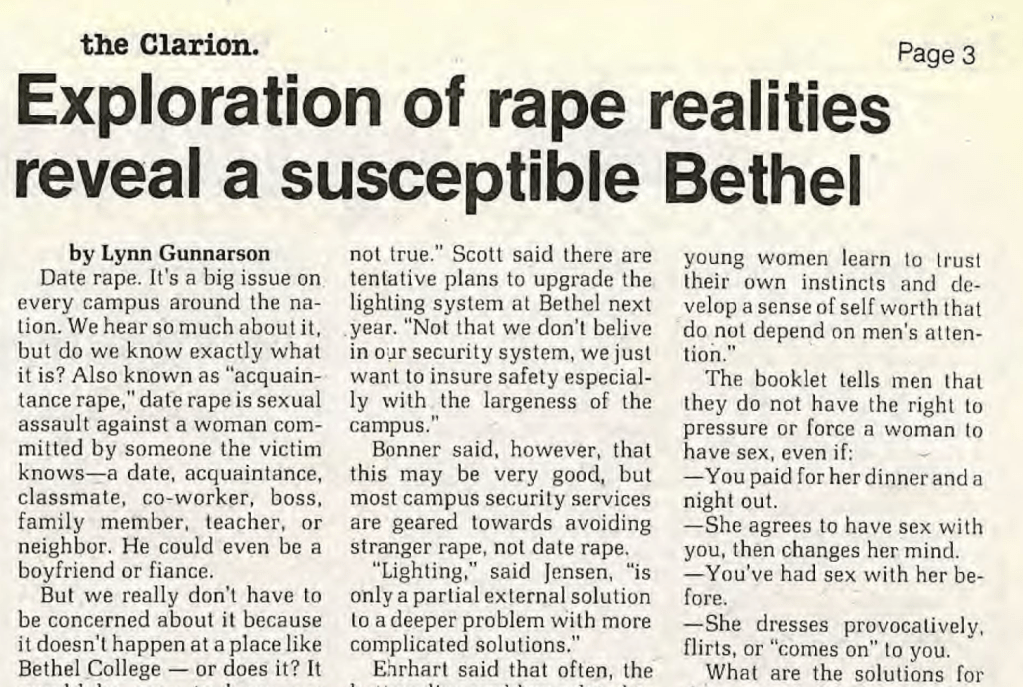
Indeed, 1975 was the year that The Clarion both editorialized in favor of loosening residence life regulations and first dedicated multiple column inches to reporting on sexual assault.24 After the student newspaper ran a two-part series on rape that fall, Marilyn Starr acknowledged that “there is cause for concern. You cannot feel secure though our campus is a secluded place. Exhibitionists and rapists look for areas such as ours…. Policemen have told me that Bethel girls are terribly naive and this attracts these types of characters.”25The Clarion continued to report on sexual assault over the next decade. A 1977 article complained that “no one talks about [rape] at Bethel. It has to do with sex, and that certainly must be against Bethel lifestyle.” Quoting one anonymous victim and alluding to “other cases of sexual assault on Bethelites,” student-reporter Paul Olsen reiterated that rape is not “provoked by the victim” or something that “happens only to bad girls.”26 A front-page article in 1981 reported on the rape of a Bethel student in the parking lot behind the Edgren and Bodien dorms, and by the middle of the Eighties, The Clarion was running its first stories about date rape on campus.27
From the May 16, 1986 edition of the student newspaper…
As the new faculty committee on Women’s Concerns began to meet in 1986, it agreed that “the problems of date rape and physical abuse and of verbal abuse need particular education.” But in the same year that the U.S. Supreme Court unanimously ruled in favor of Mechelle Vinson, a bank teller who had been sexually harassed for three years by her supervisor, WCC members also warned that “women on our campus still have ‘minor sexual harassment experiences’ and still blame themselves.”28 One such woman was 1986 graduate Patrice Conrath. Later to return to Bethel as a long-serving math professor, she recounted a troubling experience from her own time as an undergraduate: “I had a male professor in an office hold me to him and kiss me. And I just ran from the office and went and found my boyfriend at the time, who is my husband. But there wasn’t any kind of understanding at that time in society of even what to do with something like that. So it was more just, ‘I can’t believe it happened. Go and talk to somebody about it and then just try to avoid that professor as much as possible.'”29
To address such incidents, the president’s office and student and faculty committees drafted statements against sexual harassment in the fall of 1986, then a task force worked together to develop a unified policy, eventually going through at least ten drafts of that document.30 Debate continued in 1988, with a group of male College and Seminary professors arguing (as The Clarion summarized their position) that “the policy infringed on academic freedom, pinched Christian ministry and squashed due process of law. Further, the professors feared that the ‘subjective language’ of the policy sought to advance [a] ‘feminist agenda’ and that the ‘subjective language’ would convert ‘virtually every friendship into a possible lawsuit, virtually every comment into a potential charge.'”31 Nonetheless, the Board of Regents adopted Bethel’s first sexual harassment policy in early 1988. “I’m not aware of another Christian institution that has a policy that is this sensitive,” celebrated adjunct philosophy professor Carol Pass.32
“Bethel policy prohibits sexual harassment against any faculty or staff member, applicant, or student. Sexual favors may not be required either explicitly or implicitly as a condition of an individual’s employment or advancement. Sexual conduct or conduct with sexual overtones which unreasonably interferes with an individual’s work performance, or which creates an intimidating, hostile, or offensive working environment is also prohibited.”33
1991 Bethel Faculty Handbook
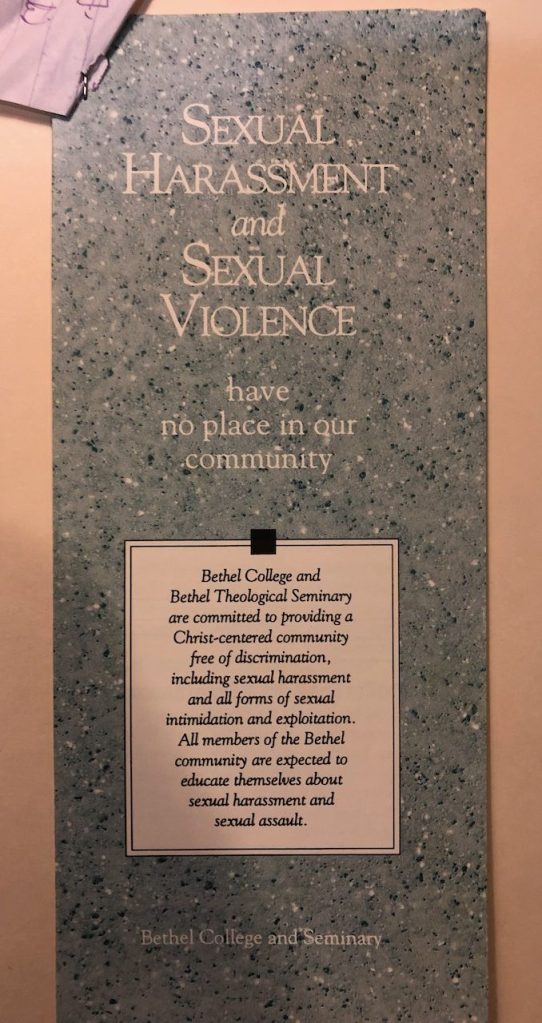
Even after Bethel expanded that policy in 1991 to cover sexual assault and began to distribute a pamphlet on sexual harassment and date rape, problems persisted.34 In March 1992 the College faculty discussed a complaint that “women at Bethel have been the object of sexist statements and actions, including the defacing of posters in residence halls, derogatory comments, and harassing phone calls.”35 Later that same month, after male students surreptitiously videotaped two female students undressing in their dorm room, President Brushaber and members of his cabinet addressed a remarkable letter to the Bethel community:
Attitudes expressed on campus in response to this incident greatly concern us. Some have suggested that “boys will be boys” and/or that the women “deserved” this. The women did not deserve this and “boys will be boys” is not an excuse to violate the privacy and rights of women on our campus….
Bethel is committed to providing a Christ-centered community free of discrimination, including sexual harassment and all forms of sexual intimidation and exploitation… We are committed to being a place where all God’s people are valued and welcomed. Women, persons of color — everyone is to be treated with respect. We are all made in God’s image. Harassment in any form will not be tolerated at Bethel. Bethel must be a safe place for women and for all of us.36
“It seems okay for men to be sexually aggressive,” concluded the authors of an internal ethnographic report on Bethel College students released that April. “Sometimes this has taken the form of sexual harassment,” with both male and female students espousing the attitudes that “boys will be boys” or that women “deserve” such treatment.37 At the end of 1992, Bethel’s governing board adopted “A Plan for Prevention of and Education Regarding Sexual Harassment and Violence,” including a series of community forums “designed to explore gender and race issues on campus,” expanded student life and campus ministry programming on “dating, sexual harassment, and gender appreciation,” and addressing sexual harassment in the first-year College Writing and selected major courses.38
The Long Struggle for Paid Maternity Leave
Bethel’s responses to the problems of sexual assault and harassment have continued to evolve in more recent decades. But rather than attempt anything like a comprehensive history of that topic, let me conclude this essay by turning to another policy that only recently went through a significant change: maternity leave.
Margaret Hartman was housemother for the first coed dorm, Hagstrom, in the early Seventies. A Clarion profile of her in 1972 was entitled, “Mom, Can I please have a Cookie?”
For at least some women in Bethel’s history, motherhood always defined their role on campus. According to Bethel archivist and historian Norris Magnuson, Annie Edgren “was said to have been nurse and mother” to many students at the seminary her husband founded in 1871. Likewise, the wife of Edgren’s successor helped extend “the kind of congenial, family-like atmosphere that characterized the Seminary,” with one alumnus remembering that Selma Lagergren “was always like a mother and friend to the students.”39 Not long after the Seminary joined the Academy on the Snelling Avenue campus in 1914, a Swedish Baptist pastor’s widow named Margreta Bodien founded the Bethel Women’s Federation, through which mothers and grandmothers in BGC congregations donated touches of home to residential students, from baked goods like cakes and cookies to handcrafted quilts and pillow cases.40 Into the Seventies, dorm life was governed in part by “housemothers” like Mae Christianson. An undergraduate in the early 1960s, future Bethel vice president Judy Moseman remembered “Ma Chris” acting as “a role model and support for me as I entered into my first attempts at leadership.”41
Yet until the last decades of the twentieth century, most of the women on Bethel’s faculty and staff either did not have children or started work after their kids were older.42 Before retiring in 1985, dean of women Marilyn Starr clarified in The Clarion that she was “not, for one second, opposed to marriage—just to the idea that my personal worth is dependent on it.” As a happily single woman, she was distressed how often “the evangelical world… proclaims that ‘oneness only comes in twos.'”43 Here again, the issue of pay disparity arose. While Starr thought things had improved since the days when “married folks were paid better than single folks,” the College’s new director of discipleship discovered that year that she didn’t make enough money to pay for an apartment. “So I went to the campus pastor at the time,” recalled Sherry (Bunge) Mortenson, “who earlier had said to me, ‘I love working with single women. They work like dogs, and they’re married to their ministry,’ which tells you volumes about the mindset of not only women, but of single women in this community.”44
“Single women could do anything in the [Baptist General] Conference and in churches and at Bethel within reason,” recalled Carole Spickelmier of her denomination and school. “They were tough women. They could hold their own. But [by the 1980s] we started having some married women.”45
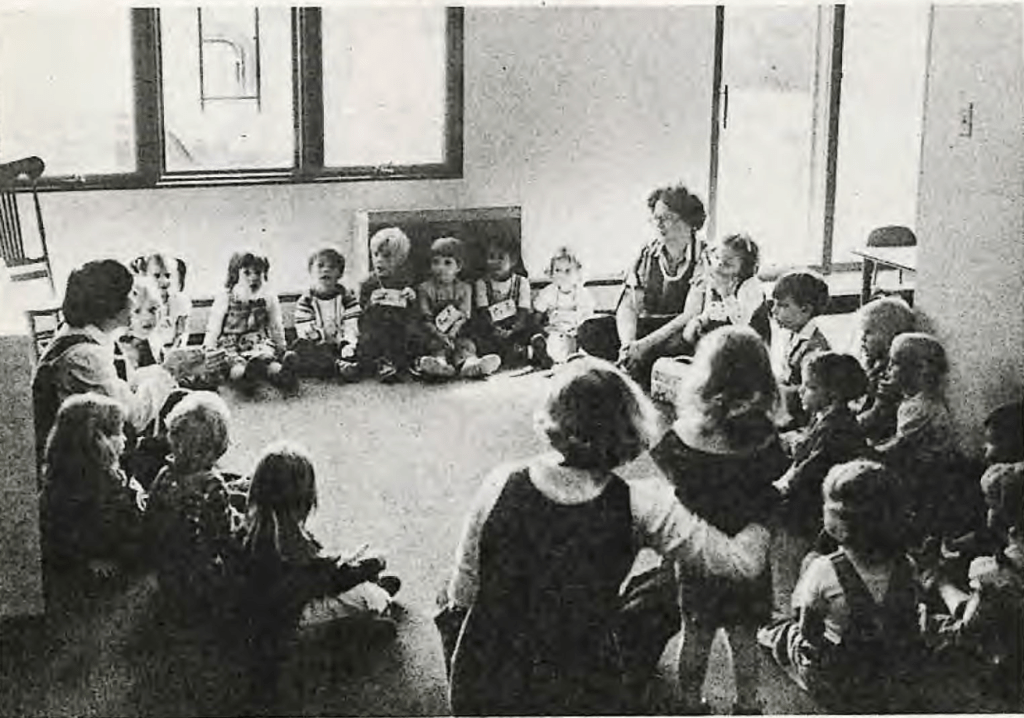
One of the first classes at Bethel’s Child Development Center, as photographed for The Clarionin September 1983.
One effect — and perhaps cause — of this shift was the 1983 establishment of Bethel’s Child Development Center. In addition to offering elementary education students practical experience in early childhood development, the CDC provided parents working and studying at the College and Seminary with an on-campus child care option. Judy Moseman, who taught in the Education Department before entering Bethel’s administration, believed that the establishment of “a preschool on campus made Bethel more attractive to women staff and benefited young families where either one could be an employee at Bethel, either the dad or the mom. I think it helped us to bring more women to campus.”46 For employees like Donna Johnson, it meant “being able to focus on my job during the week, and also knowing that [my son] was in good care at the CDC Center, which was huge.”47
But in many ways, Bethel was unprepared for an influx of working mothers, whose very presence on campus challenged the gender expectations held by some students. English professor Marion Larson recalled being eight months pregnant with her first child when she interviewed at Bethel in 1986, then having her second child during a spring break:
I just kind of decided from the beginning that I was going to sort of live this life of doing everything at the same time and having a young child and working and finishing my PhD, I was going to do that pretty publicly. And I didn’t have anyone setting an example for me of what that might look like. But I figured that it would be important for students to see what that might look like, so then they could decide if they wanted to have a life like I was trying to have.
But even as Larson and a growing number of her peers offered students a model for how Christian women could follow multiple callings at once, she heard from other working mothers on the faculty whose “students, especially male students, have given them a hard time on anonymous teaching evaluations or at other times for kind of ‘How dare you leave your children to be watched by someone else while you’re working?'”48
Meanwhile, Bethel was slow to provide formal institutional supports beyond the CDC for working mothers, leaving them to arrange informal accommodations with their colleagues and supervisors. Liz Burd, now Bethel’s director of accessibility services, was working in the Admissions Office when her daughter was born, and still appreciated how admissions director Bret Hyder made “sure that I had a space and time to be able to pump,” when Bethel didn’t provide a designated, private room for breastfeeding. “He was really pivotal in helping make sure that I had the space — both physical space and time and transition — as I entered into motherhood.”49 In her oral history interview, philosophy professor Sara Shady emphasized that Deb Harless, then dean of the College of Arts and Sciences, “graciously made some arrangements that allowed me to still maintain my health insurance and do some projects at home so I could be at home but still be employed and kind of piece it together.”50 As the parent of a child with multiple medical issues, communication studies professor Peggy Kendall was still grateful to her department chair, Leta Frazier, for making it possible “to adjust my class schedule to meet sort of my life challenges at the time… I don’t think I could have done any other kind of job if it wasn’t for the flexibility I had at Bethel.”51
However, Shady pointed out that such accommodations were necessary because “for a long time at Bethel, maternity leave was what deal could you broker, and a lot of that depended upon what your department would agree to as well.”52 With other supervisors much less sympathetic or flexible, the decades-long push for a more consistent, more generous maternity leave policy became a defining issue in the recent women’s history of Bethel.
“The college community would like to be joyful and supportive toward our members who are expecting to enlarge their families. Children are a blessing from God. We also admit that they complicate as well as enrich our lives. Our faculty colleagues each play distinct and important roles at Bethel, so it’s not easy to replace someone. Sometimes the difficulties in making the practical arrangements for classes and substitutions mask our genuine delight in our anticipated children. Still, we consider this a community, and it is our pleasure to create good ways to ‘cover’ for faculty members who anticipate using maternity leave.”53
“Maternity Suggestions” statement from Women’s Concerns Committee (1996)
Absent from its first attempt at brainstorming relevant issues in 1986, maternity leave first showed up on the agenda of the Women’s Concerns Committee in 1988, after Marion Larson joined that group.54 In a meeting that fall, new provost David Brandt agreed that what passed for Bethel’s “maternity leave policy is both unclearly written and probably also imperfect” and agreed to make it an area of focus.55 By the start of the Nineties, faculty were offered “short-term disability benefits for maternity purposes” for up to six weeks, plus a week of paid parental leave and up to five weeks of unpaid leave “for the birth or adoption of a child.”56 After the U.S. Congress passed the Family Medical Leave Act in 1993, the unpaid leave option expanded to twelve weeks.57 But even those limited benefits were problematic. “In practice,” WCC members concluded in 1996, “pregnancy does not seem to be recognized as a disability. There exists a ‘burden of guilt’ that is placed on women with regard to leaving,” with department chairs expecting women to “plan those summer babies.” Moreover, “actual ‘leave’ is not granted,” since those “faculty are still expected to keep their classes going, grade finals, etc. within normal time guidelines” — while “proper compensation is not given to other faculty who cover courses for a person on maternity/disability leave.”58
Developing more robust supports for employee parents became that committee’s overriding objective as the twentieth century ended and the twenty-first began. In 2002 the WCC both renamed itself the Family & Gender Equity Committee and secured the creation of a maternity advocate position. The first such advocate, Patrice Conrath, worked to secure accommodations for pregnant employees, such as reserved parking spots.59 Yet that same year, Conrath and fellow committee member Janet Johnson warned that the leave policy itself still lagged behind what was being offered by peer institutions. “We should be at the top!”, they wrote to human resources director Kathy Rainey. “Bethel should be very family friendly and supportive of women. This action should be flowing out of our Christian ethic.”60 But further progress stalled, with adoptive parents facing particular challenges despite the efforts of Conrath and political science professor Stacey Hunter Hecht. If the adoption of Sara Shady’s second child hadn’t taken place in the summer of 2010, for example, the one week allocated for such leave during the academic year would not have given her “even enough time for me to get to Ethiopia and back.”61
Stacey Hunter Hecht arranged leave in 2003 to adopt her daughter from China. Rosie Hecht graduated from Bethel in 2023, eight years after her mother lost her battle with breast cancer. Photo courtesy of Rosalind Hecht.
“We worked hard but were never able to achieve some of those things,” recalled Conrath, who left Bethel in 2022. “So it’s really awesome to see some of those changes now coming to play.”62 She was particularly heartened by provost Robin Rylaarsdam‘s November 2023 announcement that Bethel employees are now eligible for up to twelve weeks of paid parental leave, whether because they are giving birth, their spouse is giving birth, or they are adopting a child.63 At a time when nearly three-quarters of American workers in the private sector do not have paid family leave, that policy revision has helped to make it possible (in Conrath’s words) that “young faculty don’t have to make hard choices between their families and their academic careers, but can choose whatever type of leave that they want to do that will work well with balancing both family and academic life.”64
Letter, Charles R. Berg to Carl H. Lundquist May 12, 1969, Carl H. Lundquist Papers, Box 25, The History Center: Archives of Bethel University and Converge (hereafter HC). ↩︎
Letters, Lundquist to Gordon H. Anderson, October 18, 1965, Esther Sabel to Anderson, December 17, 1965, and Anderson to Lundquist, April 1, 1966, all in Lundquist Papers, Box 25, HC. ↩︎
Letters, Berg to Lundquist, August 5, 1969, and Gilmore H. Lawrence to Lundquist, October 22, 1969, both in Lundquist Papers, Box 25, HC. Lundquist does seem to have arranged for a slight increase in Sabel’s pension; letter, Sabel to Lundquist, October 19, 1970, same file. But ten years later, her grand-nephew (a Seminary graduate pastoring a BGC church in Pennsylvania) renewed his father’s complaints that the amount of Sabel’s pension was “a poor, if not a sinful, recompense for thirty-four years of undersalaried service”; letter, Alan C. Berg to Curt Fauth, May 12, 1980, Lundquist Papers, Box 33A, HC. ↩︎
Quoted in Sabel’s obituary, Chicago Tribune, November 19, 1993. You can find an expanded version of the story of Esther Sabel’s pension in my blog post of April 3, 2025. ↩︎
American Association of University Women, “Statement on Women in Higher Education,” 1973. Copy held in Lundquist Papers, Box 2, HC. ↩︎
Kathy Nevins, oral history interview with Christopher Gehrz and Ellie Heebsh, June 24, 2024, Women of Bethel Oral History Collection, Box 1, HC. Note that all oral history and emails interviews from 2024-25 are quoted by permission of the interviewees. ↩︎
Spickelmier added that she had been willing to accept lower pay herself in exchange for “flexibility of schedule because I had a husband who was a pastor and I had three kids”; Carole Lundquist Spickelmier, oral history interview with Christopher Gehrz and Ellie Heebsh, June 26, 2024, Women of Bethel Oral History Collection, Box 1, HC. ↩︎
Memo, Royal Bloom and Walter Wessel to Lundquist, June 7, 1973, Lundquist Papers, Box 2, HC. On the history of the Equal Pay Act, see Cynthia Harrison, On Account of Sex: The Politics of Women’s Issues, 1945-1968 (University of California Press, 1988), ch. 6. ↩︎
Minutes of ad hoc Committee on Women’s Concerns, May 14, 1986, and 1989 survey of part-time faculty by Karen Ciske, Files of Women’s Concerns Committee (WCC), HC. ↩︎
WCC minutes, March 7, 1991, and memo, George K. Brushaber to WCC, March 19, 1991, WCC Files, HC. ↩︎
Bethel University, 2007-08 reported data, Integrated Postsecondary Education Data System (IPEDS), National Center for Education Statistics, accessed June 18, 2025. ↩︎
At least, the Bethel College of that era fits Laats’ definition as well as do Wheaton, Gordon, and Biola, three other evangelical members of the Council for Christian Colleges and Universities that provide him with case studies. It’s also worth noting that just over 60% of the Bethel respondents in a 1963-64 survey of incoming Twin Cities college students identified themselves with the term fundamentalist, either by itself or in combination with words like evangelical, neo-evangelical, conservative, or orthodox; study by Bethel sociology professor David O. Moberg and students, Lundquist Papers, Box 3, HC. ↩︎
“Regulations Governing Dormitory Life,” undated [1945-46], and minutes of women’s dorm council meeting, February 4, 1946, in Women’s Dormitory Council Collection, Box 1, HC. ↩︎
Judy Moseman, oral history interview with Christopher Gehrz and Ellie Heebsh, July 11, 2024, Women of Bethel Oral History Collection, Box 1, HC. Moseman was also responsible for replacing the old dean of women and dean of men positions with associate deans, to “acknowledge the broader gender-free role that they played.” ↩︎
Barb Martin, oral history interview with Christopher Gehrz and Ellie Heebsh, August 15, 2024, Women of Bethel Oral History Collection, Box 1, HC. In the mid-Nineties, Martin helped champion an initiative to meet the needs of single parents in the student body; see minutes of WCC, March 26, 1996 and October 22, 1996, Cragg Papers, HC. ↩︎
1975 was also the year that the term “sexual harassment” was coined at Cornell University; see Fred Strebeigh, Equal: Women Reshape American Law(W.W. Norton, 2009), ch. 15. ↩︎
Anthropology professor Tom Correll, who taught a J-term class on sex crimes, claimed to know of at least three other rapes at Bethel in 1980-81; The Clarion, April 24, 1981, 1. The story on date rape is in The Clarion, May 16, 1986, 3, where a student who organized a support group for victims of sexual assaults said she knew of 10-15 such cases. ↩︎
WCC minutes, May 14, 1986 and September 24, 1986, WCC Files, HC. On the Vinson case, see Strebeigh, Equal, 209-17, 248-305. ↩︎
Patrice Conrath, oral history interview with Christopher Gehrz and Ellie Heebsh, July 26, 2024, Women of Bethel Oral History Collection, Box 1, HC. ↩︎
The Clarion, November 14, 1986, 1-2; see also memo from Jim Koch and George Brushaber, November 23, 1987 and draft policy statement of December 31, 1987, Carole Cragg Papers, Box 1, HC. ↩︎
The Clarion, October 21, 1991, 1, 16. See also editor Julianne Jackson’s article on date rape in The Clarion, November 1, 1991, 9, 16. ↩︎
Minutes of College Faculty meeting, March 3, 1992, Cragg Papers, Box 1, HC. ↩︎
Letter from George Brushaber, David Brandt, Judy Moseman, and Shari Anderson, March 18, 1992, Nevins Papers, Box 5, HC. ↩︎
Harley Schreck, Judith Moseman, Jim Koch, et al., “Bethel Student Culture: an Ethnographic Study of Bethel College Students,” April 10, 1992, in Bethel Reports Collection, Box 28, HC. The quotation comes from p. 75. ↩︎
Bethel Board of Regents, “A Plan for Prevention of and Education Regarding Sexual Harassment and Violence at Bethel College and Theological Seminary, St. Paul, Minnesota,” adopted December 1992, presented to Minnesota attorney general and higher education coordinating board, January 15, 1993, in Bethel Reports Collection, Box 28, HC. ↩︎
Of course, single women still play important roles on campus. For example, business professor and department chair Bethany Opsata discussed how “God has used my singleness for a purpose” in her oral history interview with Christopher Gehrz and Ellie Heebsh, July 30, 2024, Women of Bethel Oral History Collection, Box 1, HC. ↩︎
Sherry Bunge Mortenson, oral history interview with Christopher Gehrz and Ellie Heebsh, August 16, 2024, Women of Bethel Oral History Collection, Box 1, HC. Emphasis original. ↩︎
Moseman oral history. It’s worth mentioning, however, that attracting more women to Bethel’s work force was never mentioned as a founding goal of the CDC. Instead, early planning centered on the benefits of starting a laboratory school for the Education Department, serving the needs of Seminary student families (who were already using a small day care program housed in Seminary Village), and reaching out to the surrounding community. See memo, George Brushaber to Gordon Johnson and Dick Daniels, March 30, 1982, and memo from Brushaber, July 13, 1983, in Provost Office Collection, Box 2, HC. ↩︎
Donna Johnson, oral history interview with Christopher Gehrz and Ellie Heebsh, July 24, 2024, Women of Bethel Oral History Collection, Box 1, HC. By the same token, the closure of the CDC in 2019 was a blow to the teachers and students who worked there, and to young parents on campus; see The Clarion, October 27, 2019. ↩︎
Marion Larson, oral history interview with Christopher Gehrz and Ellie Heebsh, July 16, 2024, Women of Bethel Oral History Collection, Box 1, HC. ↩︎
Liz Burd, oral history interview with Christopher Gehrz and Ellie Heebsh, July 31, 2024, Women of Bethel Oral History Collection, Box 1, HC. In her oral history interview with Heebsh on August 2, 2024, graphic design professor Jessica Henderson noted that “there is no place to pump when you come back as a breastfeeding mother here. I mean, I have been walked in on at my office more than once”; also in Women of Bethel Oral History Collection, Box 1, HC. ↩︎
Sara Shady, oral history interview with Christopher Gehrz and Ellie Heebsh, July 30, 2024, Women of Bethel Oral History Collection, Box 1, HC. ↩︎
Peggy Kendall, oral history interview with Christopher Gehrz and Ellie Heebsh, August 14, 2024, Women of Bethel Oral History Collection, Box 1, HC. ↩︎
Preface to draft proposal from WCC, “Implementing Bethel College Policies on Maternity Leave,” undated [November 1996], in Cragg Papers, Box 1, HC. ↩︎
Minutes of ad hoc Committee on Women’s Concerns, May 14, 1986, and minutes of Women’s Concerns Committee, September 13, 1988, both in WCC Files, HC. ↩︎
Minutes of WCC, November 8, 1988, WCC Files, HC. ↩︎
Bethel College and Seminary, Faculty Handbook, 1991, Nevins Papers, Box 3, HC. ↩︎
Bethel College and Seminary, Faculty Handbook, 2000, Cragg Papers, Box 1, HC. ↩︎
Memo to Carole Cragg, October 21, 1996, Cragg Papers, Box 1, HC. ↩︎
For a fuller account, see Patrice Conrath, “A History of Maternity Issues at Bethel College (1996-present),” March 20, 2003, in Cragg Papers, Box 1, HC. In a 2000 devotional reflection, Conrath recounted how, “[a]fter a 3 a.m. feeding session with my baby, I couldn’t get back to sleep. Fears about childcare, the new semester, church, and my family all crowded into my thoughts. It was another ‘middle of the night fright'”; Bethel Women’s History Month Devotional (2000), Files related to Women’s History Month, HC. ↩︎
Memo, Janet Johnson and Patrice Conrath to Kathy Rainey, April 22, 2002, WCC Files, HC. ↩︎
See Molly Wilson’s report on the new parental leave policy and its early implementation in The Clarion, May 14, 2024. ↩︎
The paid family leave statistic comes from a 2023 Bureau of Labor Statistics report, cited in Molly Weston Williamson, “The State of Paid Family and Medical Leave in the U.S. in 2025,” The Center for American Progress, January 15, 2025; Conrath oral history. ↩︎





 The Women of Bethel