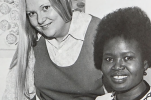
Women have always been part of the story of Bethel University; hopefully, this project starts to restore them to a central place in Bethel’s history. For what Bethel history professor Jim Johnson wrote in 1985 is still true forty years later: “Women’s history is alive and well, and our task at Bethel College [now University] is to join in and be part of such a movement, rather than be left out and deny the validity of historical reality.”1
But as my contribution to the women’s history of Bethel concludes, the work of others naturally begins.
For history is never complete. Our present and our future become our past, continually extending our story and frequently changing our perspective on it. New evidence will come to light, and new questions will be asked of older sources.
In any event, history is always an act of interpretation. Even if I’ve somehow avoided factual errors,2 the subjective meaning that I’ve made of this story is open to debate. If nothing else, I have to accept that a man’s attempt to write about women’s history will likely fall short of his best intentions.
While you’ll find thousands of words and dozens of photos and video clips here, this work ought to continue. So let me conclude by suggesting to future historians some possible avenues of further research and ongoing revision. I’d be especially tickled to pique the curiosity of two distinct groups: Bethel students engaged in their own scholarship and external scholars who find Bethel a useful case study for larger projects.
• Like every historian since Thucydides, I’ve sometimes run into a lack of sources. That’s always a problem when we turn to Bethel’s sparsely documented first half-century. But even more recent developments can be challenging to narrate and interpret. First, while I think I did reasonably well to reconstruct stories of women at Bethel Seminary and Bethel College, the university’s newer adult and graduate programs have left behind much less evidence.3 Second, I regret that we were able to conduct oral history or email interviews with only a few women of color, since several invitees either had to decline our requests or didn’t respond to them.

Even the sources I did find suggested ways that the stories of gender and race intersect in Bethel’s recent history. Some of the early Nineties responses to sexual harassment that I discussed in my “Policies and Persons” essay emerged in tandem with responses to a racially motivated attack on social work professor Nicholas Cooper-Lewper.4 In 2006 the Brushaber administration adopted a strategic plan that aimed to build an “institutional culture that honors both genders, all races and cultures,” in part through “increasing representation of women and people of color” in multiple constituencies — e.g., “doubling the faculty of color and increasing by 10% the number of faculty women” in each unit of the university.5 Even as Bethel has made some progress towards such hiring goals, retention has been a struggle. “I can understand a little bit about what it’s like to be on the margins as a female here,” philosophy professor Sara Shady told us in her oral history interview. “But it’s a whole other ballgame if you’re a woman of color. I’ve known women of color who have left because of — it’s more often microaggressions, I think, than macroaggressions, although the macro blatant things do happen as well.”6
So while I only addressed the experiences of women of color intermittently in this project, that topic could certainly sustain more focused scholarly attention — perhaps as part of a larger study of the history of race at Bethel University.7
• Less frequently, the historian’s challenge is an abundance of evidence.8 Former presidents George Brushaber (1982-2008) and Jay Barnes (2008-2020) both play important roles in this story — e.g, in hiring some pioneering women leaders. But while each president left his papers to the Bethel archives, I wasn’t able to investigate those collections as thoroughly as I’d once hoped. Because I had decided long ago that I would put the completion of this project on a fixed deadline, I simply ran out of time to do more than pass quickly through boxes of presidential speeches, minutes, correspondence, strategic plans, and other documents and will have to leave that work for someone else to take up with more diligence.
• But then I also hesitated to interpret the period of Bethel history that overlaps with my own tenure (2003-present), which coincides with all of the Barnes and Ross Allen presidencies and the last five years of Brushaber’s time in office. It’s often a challenge to make meaning of the most recent past, since we may be too close to see it clearly. Perhaps with another decade or two of distance, I’ll try again. But I’ll still be leery of writing about topics where I know I’ll either be tempted to draw on my own fallible memory or be challenged to write objectively about close friends.9 So I hope that, longer after I’ve retired, future historians will take a broader, perhaps more dispassionate view of women in Bethel’s 21st century.

• Then there are the topics that, however interesting and significant, couldn’t quite fit into our four main essays. Some did spur shorter blog posts along the way, so I’d be delighted to learn that what little I dashed off on topics like the growing number of women faculty and students in STEM fields, how Bethel folk celebrated Women’s History Month, and the role of men in the women’s history of Bethel piques another researcher’s curiosity.
For all its limitations, I hope that this project demonstrates how a change in perspective can revise and refresh our understanding of Bethel’s history. Recentering Bethel’s story on its women not only changes the cast of characters but poses different questions that have to be answered with different sources and methods.
For the most part, the Bethel I saw from this vantage point was recognizably similar to the Christian university to which I’ve committed virtually all of my work as a teacher and some of my attention as a scholar. But more often than I found comfortable, writing the women’s history of that institution also pushed me to contemplate challenges and frustrations that my female colleagues and students have known intimately. If you’re like me, any particular essay, paragraph, or sentence in this project might have left you feeling inspired, angry, excited, disappointed, or just perplexed at the complexity of women’s experiences at this university.
Christian communities are as sinful and saintly as the individuals that compose them, and we’ll never be the truth-seekers and learners we claim to be if we can’t first be honest about our own past. But we do this in the faith that God has always worked through flawed persons in ways that we don’t always see, in the hope that seeking uncomfortable truth in the past will help us to chart a future course that’s truer to our identity in Christ, and in the love that we share with our neighbors in time, for God and for all those made in his image.
So if reading any of these words has inspired you to take up the important work of studying the women’s history of Bethel University, let me encourage you with the same scripture that so often encouraged me over the last fifteen months: “Always give yourselves fully to the work of the Lord, because you know that your labor in the Lord is not in vain” (1 Cor 15:58, NIV).
Introduction | Debating Gender | Women in Ministry | Policies and Persons
Women and Sports | Conclusion
NOTES
- The Clarion, April 26, 1985, 6. Johnson was reporting on a women’s history panel hosted by the Conference on Faith and History, an organization whose first woman president, Shirley Mullen, worked as a resident director and adjunct instructor at Bethel before becoming a professor and provost at Westmont College and the president of Houghton University. ↩︎
- Where those mistakes exist, please do let me know. One advantage of this history’s digital format is that it’s easy to make corrections. ↩︎
- You can find those programs discussed in our oral history interviews with Nikki Daniels and Stephanie Williams O’Brien, Women of Bethel Oral History Collection, Box 1, The History Center: Archives of Bethel University and Converge (hereafter HC). Note that all oral history and email interviews from 2024-25 are quoted by permission of the interviewees. ↩︎
- Both topics, for example, were on the agenda of the College Faculty meeting on March 3, 1992 — see the minutes held in the Carole Cragg Papers, Box 1, HC. For more on the attack on Cooper-Lewter, see The Clarion, March 6, 1992, 1. ↩︎
- President’s Leadership Team strategic planning document, June 2006, President’s Office Collection, Box 4, HC. Emphasis original. ↩︎
- Sara Shady, oral history interview with Christopher Gehrz and Ellie Heebsh, July 30, 2024, Women of Bethel Oral History Collection, Box 1, HC. ↩︎
- Perhaps something akin to this historical review of race relations at Wheaton College published in 2023. ↩︎
- Here let me reiterate my introduction’s acknowledgment of the fine work done by our archivists and digital librarians! ↩︎
- I fear that I’ve sometimes worked too hard to remain dispassionate. Now that I’m at the end of the project, I’m dismayed to realize how little I wrote about my close friend Stacey Hunter Hecht, a political science professor and faculty leader whose death from cancer in 2015 is still felt deeply in our community. Her absence from our oral history project is a gaping and painful hole in that collection. ↩︎
 The Women of Bethel