This summer I don’t expect to blog here very much, as I start to write the final set of essays that will conclude this digital project. But it occurred to me that I could still use this blog to say more about a group of Bethel women who won’t feature prominently in a project that focuses on the experiences of students and employees. As it happens, they’re also part of a larger group of Christian women who are the subject of a new book from a best-selling Christian historian.

As a sequel to her much-discussed The Making of Biblical Womanhood (Brazos Press, 2021), Baylor University professor Beth Allison Barr — for six years a co-blogger with me at The Anxious Bench — decided to attempt another combination of historical narrative, biblical reflection, and memoir. Married to a Baptist pastor herself, Barr wanted to know how Becoming the Pastor’s Wife had come to be seen as a divine calling — not to the independent or co-equal spiritual authority that women exercised in early and medieval Christianity, but as a subordinate partner to a man who was her head in church and home. Why, she wondered, were Baptist women like her often expected to put their own careers second to their husbands’, even to do ministry work for which they weren’t typically paid?
As in her previous book on women’s roles in evangelical Christianity, in Becoming the Pastor’s Wife Barr draws on both personal experience and her training as a medieval historian, sharing firsthand insights into contemporary women’s experiences that contrast with those of Christian women living centuries earlier. “I had spent the past few years earning a PhD in medieval history,” she writes early on, of an encounter with a complementarian pastor in Waco evidently troubled by the idea of a woman pastoring a church. “How could I perceive a woman preaching in my twenty-first-century town as wrong when I knew that medieval Christians perceived Mary Magdalene as the first preacher to the disciple, the ‘apostle to the apostles’?” (2-3)
What had changed over time, such that the Church had moved away from recognizing the authority of women like the 5th presbyterae Leta and Martia (43-44) or the 8th century abbess Milburga (ch. 3)? Barr does argue that the role of pastor’s wife as evangelicals know it was born “in the turmoil and fear and hope of early sixteenth-century Germany” (84), when Protestant reformers like Martin Luther rejected clerical celibacy and closed the monastic communities that had given women like Milburga and the more famous German abbess, Hildegard of Bingen, powerful roles in the Church. But for all the historic importance of the Protestant Reformation, “it wasn’t until the second half of the twentieth century that [being the pastor’s wife] was elevated as the highest calling for many Protestant women, waxing in importance as more independently authoritative roles for women waned” (xix). For example, of the 150 books advising pastors’ wives that Barr and her graduate student collaborators read during their research, “one-quarter were published between 1950 and 1989” (122).
That era overlaps with the rise and fall of women’s ordination in the Southern Baptist Convention, “the largest and most powerful white evangelical denomination in North America,” whose contemporary history “has both informed and exemplified this version of the pastor’s wife role during the last half of the twentieth century” (xviii-xix). But as I read Barr draw on her research in the SBC archives and her experience in Southern Baptist institutions, I wondered how much her story overlapped with the one I’m telling about women affiliated with a much smaller Baptist denomination that originated in Swedish Pietism.

When the seminary of the Baptist General Conference moved to its new campus in Arden Hills in 1965, only three women were enrolled as full- or part-time students. Edna Schultz worked as secretary to dean Gordon Johnson (then later as Seminary registrar), but there were no women on the Bethel Seminary faculty, Esther Sabel having long since moved to the College and then retired. However, there were dozens of women living and even studying on campus: the wives of male seminarians.
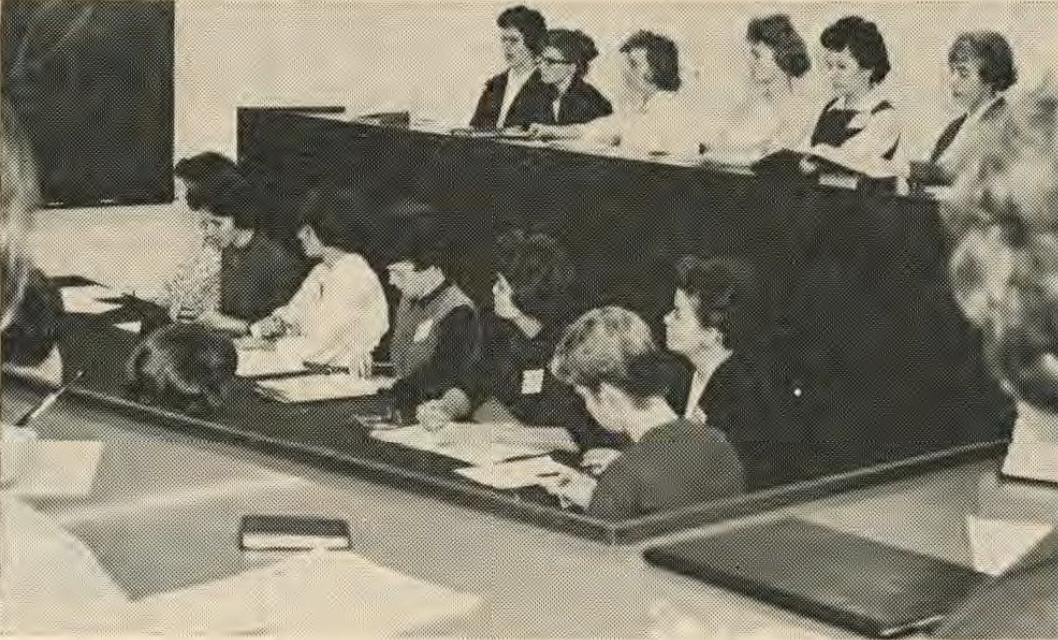
That fall Clarion readers saw a report by Diana McConnell, president of the Seminary Student Wives Fellowship. She described how forty of those women gathered every Monday night for classes taught by Seminary professors: “Dead Sea Scrolls” by Old Testament professor Ronald Youngblood and “Counseling for Pastors’ Wives” by dean emeritus Edwin Omark, who emphasized the importance of self-knowledge, since “we cannot counsel with others until we have solved our own problems.”
Likewise, a 1968 article in The Standard emphasized that the “Seminary wife works toward her role-to-be as her husband trains for his.” Fall evening classes let those women “become acquainted with subjects their husbands are studying and… learn about various fields of leadership within the church.” In the spring the Seminary dean and his wife mentored them in public speaking. “The Seminary wife is encouraged to be herself,” reported the magazine of the Baptist General Conference, “and to accept what she is as what the Lord has given her. She accepts His power through her. She is challenged to be honest with herself, with her husband, with God. Mrs. Johnson likes to point out the truths in the statements: ‘The Spirit of God has no inferiority complex, Don’t feel that you have to fit someone else.'”
The Faculty Wives of Bethel Theological Seminary, being confident of the good character, Christian experience, and approvedness in matrimonial arts and culinary sciences, and upon the successful completion of the prescribed course of patience and perseverance do hereby confer upon Mrs. Seminarian Wife with all the rights and privileges thereto appertaining, the degree of P.H.T., Proppelans Hominis Sui Triumphata (otherwise known as Pushing Hubby Through) according to the authority vested in us by the very august assembly of Bethel patriarchs, with the hearty concurrence of faculty and scholars, under the laws of connubial bliss.
Text of the diploma awarded to wives of graduating seminarians in 1968 at a special party hosted by faculty wives
Entering the 1970s, the Seminary Wives Fellowship maintained its mission: “To help Bethel Seminary Student Wives better understand and prepare for their role as wife of the pastor, missionary, or one called into full-time Christian service. To provide mutual encouragement and Christian fellowship for Seminary Student Wives and their husbands.” In 1972-73, its list of workshops included “Communication in Family Relations,” “Gracious Entertaining On A Limited Budget,” and “Tips on Hosting Bible Studies” — led by “Mrs. Mickelsen” (i.e., College journalism professor and Seminary faculty wife Alvera Mickelsen).
That group soon rebranded as Women Alive to encompass the Seminary’s small but growing number of women students and staff — including Jeannette Bakke, who became the second woman to join the full-time Seminary faculty in 1978. But Women Alive continued to give “Seminary wives monthly opportunities to share their common situations and help strengthen relationships,” according to a 1982 Standard article on “The Making of a Minister” that also noted the creation of a new certificate program for those women that included Bible studies, regular Seminary classes, and a Lay School of the Bible offering on “The Minister’s Wife.”

There’s much that our archives don’t record of the experiences and persectives of Bethel women who didn’t receive seminary degrees but were still being prepared to join their husbands in ministry. (As always, I’d welcome comments below!) But I’ve been pondering how my limited sketch compares to and contrasts with Barr’s account of the pastor’s wife in American evangelicalism.
Barr does not focus on how the wives of future pastors experienced seminary life. However, she does recall her husband’s alma mater, Southeastern Baptist Theological Seminary, offering classes for seminary wives. Under Southeastern’s then-First Lady Dorothy Patterson (the author of the widely-read Handbook for Ministers’ Wives), one lecture was dedicated to “how to pack your husband’s suitcase properly,” and future pastors’ wives learned “that the condition of their homes reflected the condition of their spiritual lives” (89). Similarly, Al and Mary Mohler founded the Seminary Wives Institute at Southern Baptist Theological Seminary in 1997. In recent years, its “Essentials” course has assigned readings from complementarian manuals like Gloria Furman’s The Pastor’s Wife and Christine Hoover’s How to Thrive as a Pastor’s Wife. Faculty wives teach that class, while the Bible survey is headed by male professors (148-49). This fall’s SWI catalog at Southern also offers courses in discipleship, communication, and “Women of the Bible.”
Those seminaries’ women’s programs have meant that Southern Baptist churches could call pastors whose wives were not only oriented to the expectations of their role but had some training for often unpaid ministry — without any expectation of ordination. So while I don’t know how the content of seminary wives’ courses at Bethel Seminary compared to those at its Southern cousin institutions, what’s no doubt most striking about reading the two stories in tandem is that Bethel was slowly beginning to embrace its role in educating women called to ordained ministry at the very same time that the 1980s/1990s “conservative resurgence” in the SBC was closing off such roles to women.
One goal of this blog is to help involve members of the Bethel community in doing the history of Bethel, so comments are always welcome! Today I’d especially appreciate memories from pastors’ wives who were at Bethel Seminary with their husbands: Did you were part of the seminary wives fellowship or take classes like those I’ve mentioned? How did the dynamics of that group change as it added women seminarians? If you’ve read Beth Barr’s book, what do you think of her analysis? Just know that if you leave a comment at the project blog, I’ll take that as expressing your permission to quote it in the project.
 The Women of Bethel