
I love cooking almost as much as studying history, and cookbooks are some of my favorite historical sources. For example, when we look at 19th century views of gender in my upper-level survey on Modern Europe, I like to introduce students to Mrs Beeton’s Book of Household Management (1861) as we eat scones I’ve made according to her (rather bland) Victorian recipe.
So you can only imagine how thrilled I was to find a Bethel cookbook last week in the Bethel archives. But let me give you some context before we get to its content…
In 1916, two years after Bethel relocated to St. Paul, a pastor’s widow named Margreta Bodien helped organize the Bethel Women’s Federation (BWF). While its charter membership includes the wives of A.J. Wingblade, the principal of Bethel Academy, and Adolf Olson, the Seminary’s new church history professor, most of the women who supported Bethel through the new organization were simply loyal members of local Swedish Baptist congregations: first- and second-generation immigrants who wanted to support one of the central institutions of their community. In 1968 the Women’s Federation renamed itself the Bethel Auxiliary — “to more easily identify ourselves as a service organization,” explained first lady Nancy Lundquist — though its membership continued to consist of women connected to Bethel and Twin Cities churches in the Baptist General Conference.
As the magazine of Bethel’s denomination explained on the occasion of the organization’s 50th anniversary, the BWF “picks up the tab for many of the extras at Bethel… women of the Federation are much of the time throughout the school-year giving of their time, lending assistance, that Bethel may be a more complete and comfortable place and that her total program might run smoothly.” That assistance took many forms over the years. Its “most important project,” according to a 1971 Clarion profile, had women praying for each new Bethel student.
But the Women’s Federation also offered more material support. First, BWF members supplemented dining services for what used to be a much less affluent student body. That meant baking cakes and cookies (over 3,300 reported for 1961-62 alone) throughout the year and — at least in the organization’s first decades — holding “fruit showers” in October, when Midwestern housewives were busy canning produce in advance of winter.
“Now we no longer bring our canned fruit,” wrote the wife of Seminary professor Reuben Omark in October 1953, “but instead we will bring cleaning cloths — and as many as possible! Unless we bring them, the school must purchase them, so let’s make this unnecessary by bringing a really liberal supply… there is also a need for heavy ironing board covers, dresser scarves (plaid or checked prints) and bed pillow protectors with a zipper or draw-string closing.” The organization’s sewing committee kept working as Bethel moved from St. Paul to Arden Hills, donating 17 quilts, 101 dish towels, 82 pot holders, 54 pillow covers, and 12 dish rags in 1968-69, and later producing dozens of student smocks, teacher aprons, and stuffed animals for Bethel’s new Child Development Center in the 1980s.
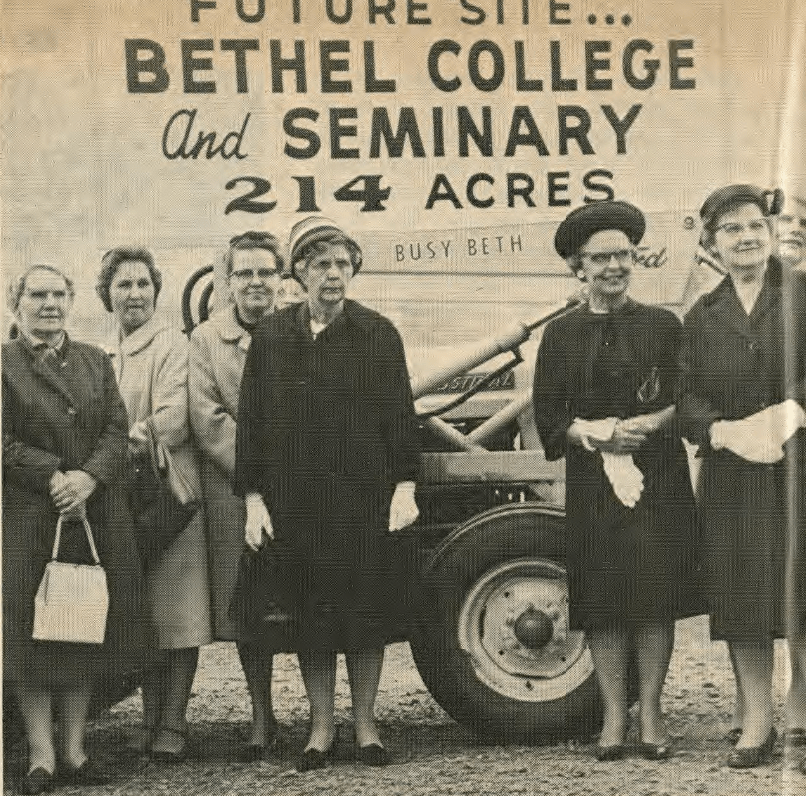
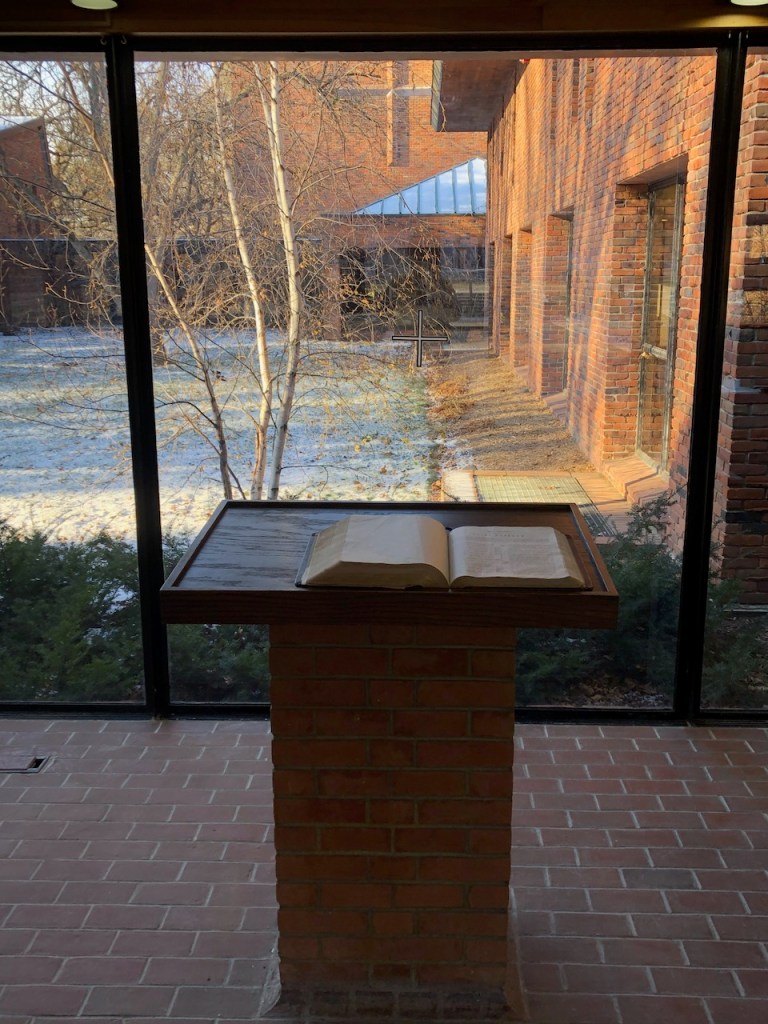
Other members volunteered their time to provide clerical assistance for the speaking events of Founders Week or campus vaccination campaigns. But perhaps the most enduring support of the BWF/Auxiliary was financial, raising funds for annual projects at the cash-strapped institution. For example, a BWF-funded tractor named “Busy Beth” (below, left) worked on the new campus as Bethel prepared to move to Arden Hills in the 1960s. In the lobby of the oldest academic building by Lake Valentine, you can still find a brick pedestal holding a pulpit Bible (below, right) — paid for by a $2,800 BWF campaign in 1965-67. As the Nursing program began in 1982, the Auxiliary’s women sought to raise $6,000 to equip its new laboratory.
Other campaigns helped to offset the rising cost of tuition. In the early 1970s, the Auxiliary raised nearly $7,000 to fund a scholarship for Ethiopian student Tekle Gebre Selassie, who had converted to Christianity at a Billy Graham crusade and attended a Mennonite school. In 1988 it endowed three $500 scholarships for “Bethel College students who have demonstrated an interest in discipleship and spiritual growth of students on campus” — scholarships inherited in the 1990s by a new group of women and men known simply as Friends of Bethel.
Then there’s the campaign that took place in 1984-85… To help buy the cameras, microphones, monitors, and other equipment needed for a closed-circuit video system in the Seminary’s preaching practicum, members of the Bethel Auxiliary sold their own cookbook for $6.50 a copy (about $19 today).
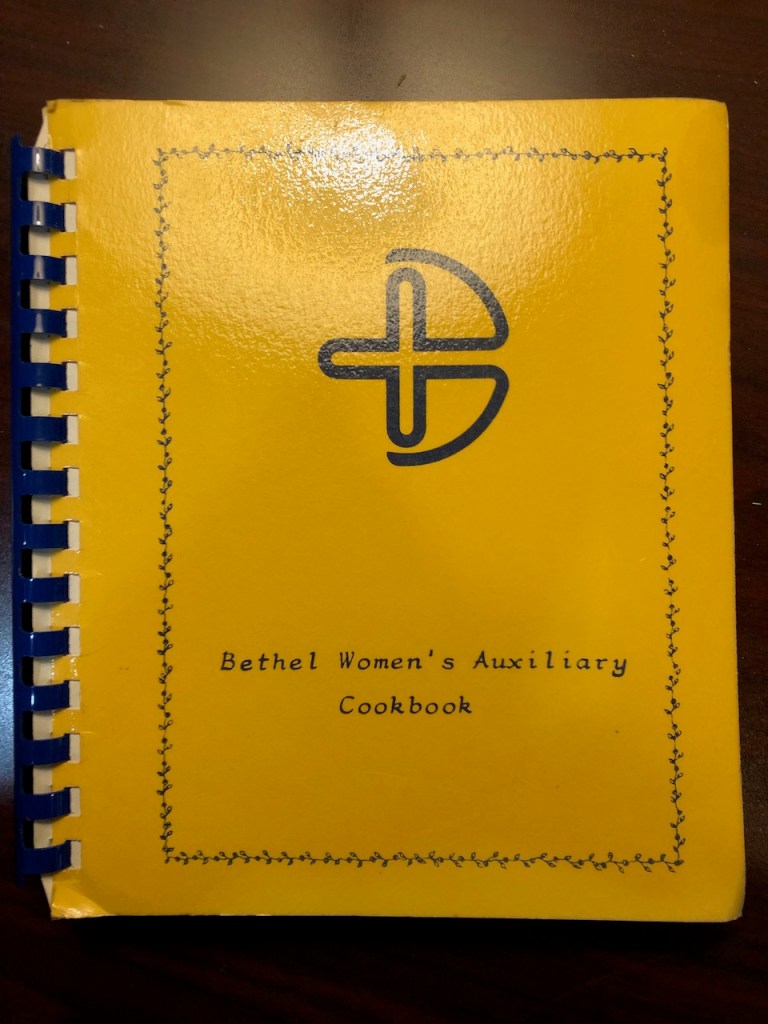

There’s some unexpected variety in the contents of this particular cookbook. Helen Lewis, who had been a missionary in Portugal alongside her Bible professor husband, Art, likely introduced many readers to dishes like Mulligatawny Soup, Tabbouleh Salad, and a “Chicken, African-style” that had peanut sauce and avocado, banana, and coconut among other suggested toppings. But not surprisingly, casseroles and hot dishes account for forty of the cookbook’s 300+ pages, and fruit and Jello salads another ten. Redolent of the Midwestern church cookbooks so common in the 20th century, it’s an artifact of the last years of Bethel as the denominational enclave and close-knit family that many of the older women we interviewed this summer described it as.
Most of the cookbook’s contributors were BGC church members and College alumnae, but some were more permanent members of the Bethel community. You can find five recipes from Nancy Lundquist (all but one featuring almonds or almond extract) and four from her successor as Bethel’s first lady, Darleen Brushaber (ranging from enchiladas to chocolate sauce). Bethel staff members and staff wives submitted recipes for everything from Almond Tea Bread (Mary Twogood) and English Toffee (Flossie Winquist) to Paella (Ana Ortiz). Faculty wives are also common, none more prolific than Ruth Anderson (wife of philosopher Stan) and Doris Bass (wife of Seminary professor Clarence).
However, it’s notable that the only professor I saw named in the cookbook was a man: voice instructor Gerard Sundberg of the Music Department offered his take on Sour Cream Raisin Pie. Adele Greenlee shared her Cracked Sugar Cookies, but she wasn’t yet a member of the Education Department.
Earlier in its history, the Bethel Women’s Federation had close ties to the few women then appointed to the Bethel faculty. Bible professor Esther Sabel served as BWF president after World War II, and when German instructor/dean of women Effie Nelson was honored at Bethel’s 90th anniversary dinner in 1961, she made a point to “thank God for the members of the Bethel Women’s Federation. All through the years and at the present time the women have given freely of their time, their talents, and their friendship.”
So I wonder if the absence of such women from the pages of the Auxiliary’s cookbook speaks to some cultural changes underway by the mid-Eighties. Though certainly committed to Bethel, the growing number of women on faculty at that time often had a different relationship to the school. It wasn’t an offshoot of their church for those coming from different denominational backgrounds, and those who were raising children of their own weren’t necessarily looking for an extended family at their place of work. Most importantly, their way of supporting Bethel was to fulfill their callings as academic professionals, not to voluntarily contribute the labor of the domestic sphere.
One goal of this blog is to help involve members of the Bethel community in doing the history of Bethel, so comments are always welcome! Just know that if you leave a comment at the project blog, I’ll take that as expressing your permission to quote it in the project.
 The Women of Bethel
Thanks for mentioning my mom’s (Ruth Anderson) significant contribution to this cookbook. I remember her working on this and when it came out. My mom’s recipes in the book are for some her best and well known dishes or desserts. The book had a significant presence my house growing up. My sister has her copy now. After she died we relied on it for preserving many of her recipes and for finding the recipes from other people that she often used. It is nice to know it has been preserved in the archives.
LikeLike
I was going to send you a couple pictures of your mom’s recipes, Mark. But I’m glad that the cookbook itself still lives on in your family. It was good to see her name and think of the important roles you all have played in Bethel’s history!
LikeLike