The beginning of March “means more than approaching midterms and spring break,” The Clarion informed Bethel students that month in 1987; “it also means National Women’s History Month.” Both “a source of inspiration for women activists and achievers” and a way to help “men to expand their own appreciation for and expectations of the lives and work of women around them,” Women’s History Month (WHM) was a fixture at Bethel throughout the late Eighties, Nineties, and early Aughts.
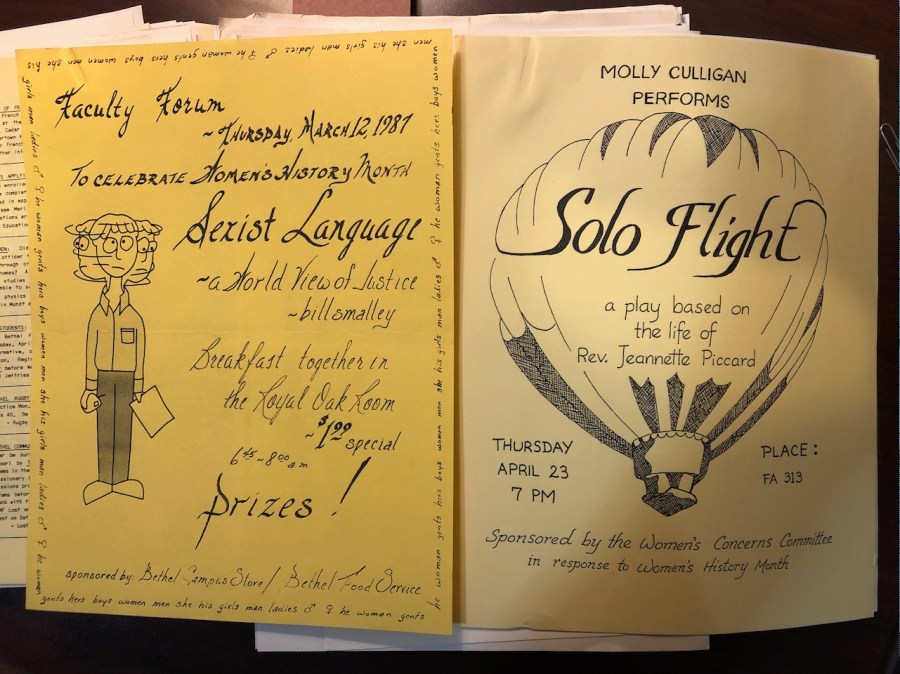
Initially organized by a faculty-staff committee, then under the Office of Student Life, Bethel’s version of WHM included a variety of events and activities. In 1987 British evangelical Elaine Storkey gave a chapel talk aimed at “exploding myths about the nature and aims of Christian feminism.” A series of talks by Ruth Tucker (co-author of Daughters of the Church: Women and ministry from New Testament times to the present) headlined a 1993 WHM that concluded with a panel discussion of the history of women’s athletics at Bethel. The following year the RC gym hosted a performance of A Woman’s Place, “a musical play about a fictional meeting of five great women of faith”; then after Benson Great Hall was completed, vocal coordinator Donna Dixon organized a concert featuring local collegiate choirs primarily singing the works of female composers. Several Women’s History Months at Bethel featured displays in the Library and academic department areas, “table tents” informing Dining Center patrons about women in history, and film forums.
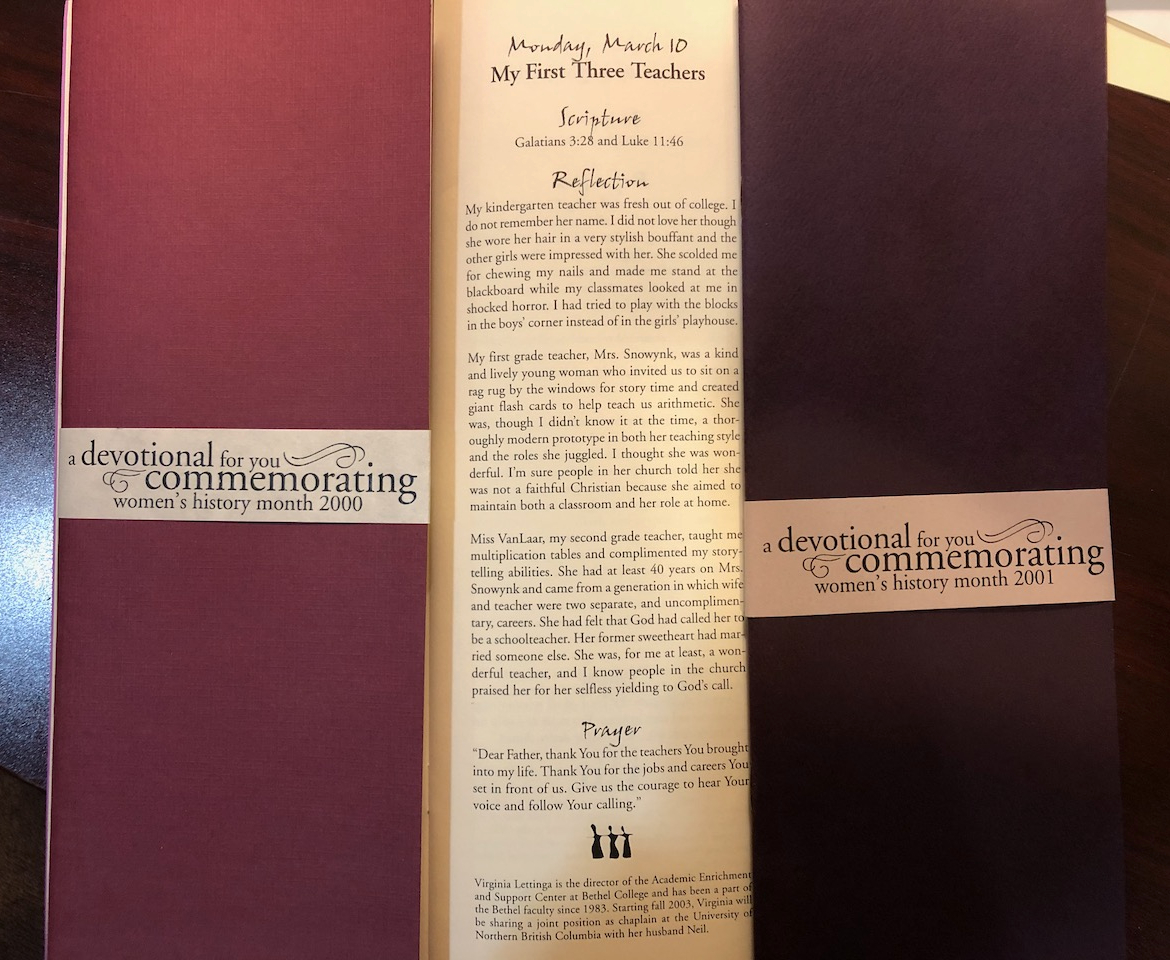
Perhaps most striking — at least to a historian looking for new kinds of historical evidence in writing the women’s history of a Christian university — was the brief series of devotionals compiled for daily use during Women’s History Month.

First proposed at a planning meeting in the fall of 1999, three WHM devotionals from the series are held in the Women’s History Month file in Bethel’s archives: 2000, 2001, and 2003. (If there were others, please let me know in the comment section below.) “It was really well done,” recalled student development dean Barb Martin when we interviewed her this past summer, “because over the month of March, we had thirty different women at Bethel who wrote a devotional, one for every day. And that was really well received, I think. Kind of a keepsake, you know, for people.”
Introducing the first devotional for March 2000, Martin reflected that during her years at Bethel, she’d felt that
one of the greatest blessings in my life has been the privilege to sit with women who have shared their stories with me in my office, over a cup of coffee, on a walk around campus, in a residence hall lounge, or even in a hospital room. It is my prayer and desire that through this devotional booklet you will have a glimpse into the lives of women who are currently or have been a part of the Bethel family. They are sharing with us moments in their lives when God spoke to them or an insight in the Christian life was gained through Scripture. May the biblical texts and the stories that follow instruct each of us to live more whole and holy lives for Jesus Christ.
Written by staff, faculty, alumni, president’s wives, and other women connected to Bethel, the devotionals didn’t limit themselves to gendered topics. Most often, they reflected on themes that could have been found in any number of Christian devotionals: e.g., the importance of trusting God amid adversity and listening for his voice through prayer. As a Christian myself, I believe that re-reading any of those reflections even twenty-some years later can still help me “to live [a] more whole and holy [life] for Jesus Christ.”
But since I’m working on a women’s history of Bethel, I was especially interested by the authors who chose to root their reflections in stories about the particular experiences of women. For example, Deborah Peterson Unruh ’80 wrote about the homeless mothers she met while running the Elizabeth House shelter in Pasadena, CA, and anthropology professor Jenell Williams Paris ’94 experienced the “upsidedown-ness” of the kingdom of God via a young girl in her neighborhood who “taught me about grace as she continued to love her family amidst constant financial and emotional disappointments.”
As the father of twins, I was particularly struck by campus pastor Sherry Mortenson’s meditation on Psalm 139 (“You have searched me, Lord, and you know me”). We have a girl and a boy, but God created her then-five year old girls, she wrote, “in such a way that most people can’t tell them apart.” That is, until a little girl at a soccer game found a way to do just that: “This one is prettier than that one. That one has prettier eyes than this one. This one has prettier hair than that one…” Mortenson recalled that incident teaching her that her daughters had been born into “a world that often labels people and sets them up to compete for their value and worth according to worldly standards rather than God’s truth of who they are in Christ.”
Other contributions focused on stories of women in the Bible, as when adjunct instructor Nancy Foster ’97 retold the story of a Samaritan woman encountering Jesus at a well and Colleen Nelson ’01 wrote about Jesus’ interaction with a crippled woman in Luke 13. In the 2001 devotional, Nursing professor Nancy Larson Olen recounted the story of Shiphrah and Puah, the “nurse-midwives” who defied the Egyptian pharaoh’s orders to murder newborn Hebrew boys. “Though the women’s work was with women and children, the least influential people in that day,” noted Olen, “God took notice of their work and their decisions. In fact, their work was of such importance that even today, more than 2000 years later, we still have their names and story recorded for all to remember.”
Most intriguing for me as a historian are the relative handful of meditations that spoke directly to themes central to our Women of Bethel project, since it makes the devotional series a unique kind of historical source. For example, a Seminary student’s reflection on Genesis 2:18 (“The Lord God said, ‘It is not good for the man to be alone. I will make a helper suitable for him'”) sheds light on how young women at Bethel wrestled with expectations about dating and marriage — and the experience of singleness. In a later post, I’ll return to several contributions that reveal the struggle for balance that the growing number of working mothers at Bethel experienced as the 20th century turned to the 21st, including the professor whose piece on the parting of the Red Sea started with a 3am breastfeeding session awakening “fears about childcare, the new semester, church, and my family.”
One goal of this blog is to help involve members of the Bethel community in doing the history of Bethel, so comments are always welcome! Just know that if you leave a comment at the project blog, I’ll take that as expressing your permission to quote it in the project.
 The Women of Bethel