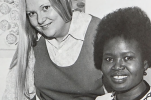

Just before Christmas 1986 a columnist in Bethel’s student newspaper sought to introduce readers to feminism by talking to some feminists on the Bethel faculty. English professor Jeannine Bohlmeyer told Julia Abbott that “feminists are not arguing for female sovereignty or matriarchy, just liberty and justice for all.” So why did evangelicals shy away from that term? “Feminism has been thrown into the same voodoo pot as secular humanism,” suggested psychologist Kathy Nevins. “When you say feminism the connotation is radical feminist, lesbian.” Yet to Nevins, who had just finished her dissertation on Christian feminism, “Christ was the epitome of a feminist. Who did he first say ‘I am the son of God’ to? He said it to a woman.”
“I have read a lot of garbage in the Clarion this year,” responded one freshman after New Year’s, “but nothing I’ve read so far has nauseated my senses or emitted such an unmitigated stench as the recent article on ‘Feminism’ in the church.” To him, feminism was “a sick and perverted ideology, one that seeks to subvert God’s true intent with a man-made mutation… the true intent of feminism… is to subvert existing traditional morals and values, even the Bible itself, in an attempt to place women in a position of superficial parity with men.”
That letter sparked a debate that raged in The Clarion until spring break. One student rejected out of hand “ideas and social changes promulgated during the last two decades by those such as Gloria Steinem, Betty Friedan and their ilk” while another insisted that “sex roles are created by society, not by God. My God is not the god of oppression—even if that oppression seems subtle or insignificant to you.” From the faculty, Nevins’ psychology colleague Mike Roe argued that “Christian feminism argues for [mutual] submission as God’s intention in relationships, and that this is demonstrated in the life of Jesus Christ,” while theologian Greg Boyd both pushed back against what he saw as anti-feminist misuse of Scripture and warned that “lumping [Christian feminists] in with whatever stereotypes one may have about ‘feminism’ is insulting to their individuality, and only builds walls, not bridges.”
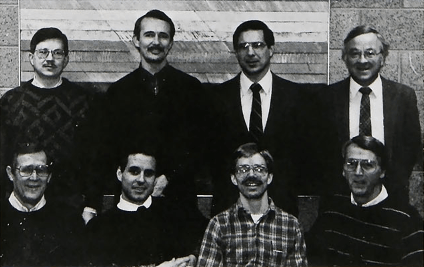
Strikingly, everyone who contributed to that debate — that is, everyone whose letter was published — was a man. For that matter, one of the most strident voices in Abbott’s original column came from history professor Paul Spickard, who went so far as to tell her, “I don’t think you can be an authentic Christian and not a feminist.”
It got me wondering: In a women’s history of Bethel University, what role should Bethel’s men play?
The ongoing debate over feminism — within American society more broadly and evangelical Christianity more narrowly — will obviously be important to this story, so I’ll surely revisit the Clarion iteration of it from 1986-87… a year that also saw faculty form what would become the Women’s Concerns Committee and the institution develop its first sexual harassment policy. Men took part in that debate, sat on that committee, and helped shape that policy.
But if the overarching goal of this project is “to tell a version of our university’s story that places women at its center,” don’t I need to take care not to let men’s voices overwhelm those of women?
This project already has a man as its lead researcher and author; as I’ve written before, it’s important to me to spend as much time as possible listening to women before I start writing anything like a polished narrative. So the project began with several dozen oral histories of key women from Bethel past and present, and I’ve conducted some more interviews this fall via email.
But while I’ve hesitated to reach out to men for comment on events and issues that involved them, I’ll probably start doing so as the project continues. Because men do play important roles in the women’s history of Bethel.
In some ways, that may just underscore what a feminist would describe as the historically patriarchal nature of the institution. Much of our story takes place in the context of male leaders making decisions and exerting influence through prominent roles that women have filled only recently (e.g., campus pastor, provost, chair of the board of trustees) or not at all (e.g., president, athletic director). To the extent that this will be a story of women experiencing inequality and disrespect, it will be fair to interrogate how much the men in charge of Bethel created, exacerbated, or neglected such problems.
But it’s also clear that Bethel men used their power and influence in other ways. To revisit two topics I mentioned earlier… from its beginning, membership of the Women’s Concerns Committee (WCC) included men like Mike Roe, sociologist Ken Gowdy, philosopher Don Postema, and historian Kevin Cragg. Another WCC member, psychology professor Jim Koch, chaired the task force that did early work refining Bethel’s sexual harassment policy.
And while the women we interviewed this summer sometimes recalled men ignoring, speaking over, and even harassing them, I think it’s fair to say that, on balance, they had more to say about men who supported, encouraged, and empowered them — as colleagues and employees, and sometimes as Bethel students themselves.

To cite just a few examples… While the Seminary has often been ground zero at Bethel and in its denomination for debates about women in ministry, the female seminary professors we interviewed most often praised their male deans for supporting their teaching and seeking to build an inclusive, irenic community. One of my favorite stock questions was to ask about fellow women who had been mentors or role models, but several interviewees went out of their way to add stories about men who played such roles for them. Deb Harless explained how Steve McNeel, one of her psychology professors, helped set her on her path to graduate school by inviting her to be his undergraduate teaching assistant. While Judy Moseman described some men as “patriarchal in their treatment” of her, she recalled Tom Johnson as her mentor in the Education Department, possessed of a “wonderful, encouraging spirit.”
And while Bethel’s short list of presidents still lacks a woman’s name, recent presidents have brought more women into institutional leadership. In 1987 George Brushaber named Moseman Bethel’s first woman vice president (in Student Life). His successor, Jay Barnes, made Harless the first woman provost in 2013, five years after hiring Laurel Bunker as the first woman to serve as head campus pastor; in their interviews, both praised him for his personal support and overarching commitment to diversity.
One goal of this blog is to help involve members of the Bethel community in doing the history of Bethel, so comments are always welcome! Just know that if you leave a comment at the project blog, I’ll take that as expressing your permission to quote it in the project.
 The Women of Bethel