
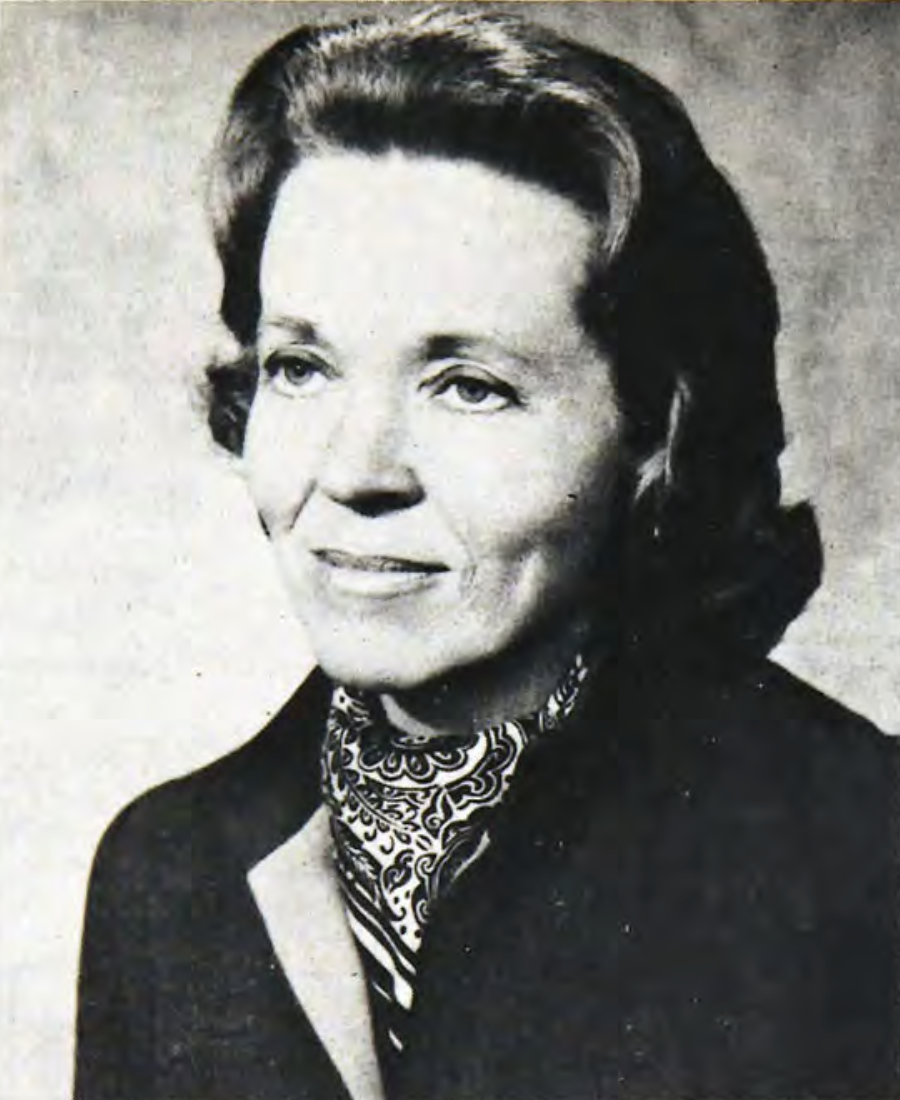
While the Seventies are often remembered as an era when even theologically conservative Christians began to rethink assumptions about women’s roles in family, church, and society, it was also an era that saw significant backlash against feminism. “I am already liberated,” explained Chicago native Joan Brand in the December 12, 1975 issue of Bethel’s student newspaper, “I am liberated by keeping God’s rules, not breaking them.”
Writing at the end of the UN’s International Women’s Year, Brand was “very thankful for those women who fought so earnestly to gain what we now have.” But she believed that feminism had gone too far:
God creates male and female according to His design. We are made to compliment [sic] the man, not to compete with him. Personally, I love being a woman and have no desire to compete. When will we realize that Christ has given us a high place? By accepting our place, we make it our business to understand what our heavenly assignment is and what we are capable of doing now. If it is God’s order for our life to have a career in marriage, then we may do it. We are ordered, however, to fit into the plans and decisions our husbands will make.
Brand’s op-ed for The Clarion could have been a primary source for Calvin University professor Kristin Kobes Du Mez, author of Jesus and John Wayne. In chs. 3-4 of her bestselling cultural history, Du Mez describes how both “separatist and ‘respectable’ evangelicals” in the Seventies came to coalesce “around the assertion of patriarchal power” (p. 75), thanks in part to anti-feminist authors and speakers who likely influenced students like Brand.
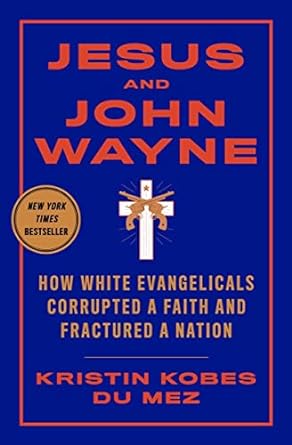
While Du Mez doesn’t mention their years on the Bethel faculty in her coverage of complementarian theologians Wayne Grudem and John Piper, several other figures from that section of her much-discussed book show up in Bethel’s historical record. For example, political scientist G.W. Carlson, the most politically active progressive on the College faculty, warned local evangelical leaders that passing a motion against the Equal Rights Amendment in 1975 would link them with the “far-right rationale” of activist Phyllis Schlafly, rather than Christian politicians like Al Quie and Mark Hatfield (pro-ERA Republicans who went on to deliver commencement addresses at Bethel in 1978 and 1984, respectively). The following year, a chapel talk on women’s submission prompted Carlson to write a sarcastic letter to the Clarion editor, suggesting the need for courses like “Man and Politics: Why Women Ought Not Have the Right to Vote” and “Classic[s] in Political Submissiveness: Marabel Morgan Through the Ages” — the latter an allusion to the popular evangelical author of The Total Woman, whose “message appealed to women invested in defending ‘traditional womanhood’ against the feminist challenge” (Jesus & John Wayne, p. 64).
That same decade, The Clarion twice reported on students attending Bill Gothard’s Institute in Basic Youth Conflicts (later renamed the Institute in Basic Life Principles), which Bethel president Carl Lundquist in 1973 called “a very worthwhile experience, whether or not you accept 100% of what Bill Gothard says.” (The 120 Bethel students expected to attend that year’s Gothard seminar at the St. Paul Civic Center would have contributed to a total attendance of over 200,000 around the country.) Three years later, a student gave a mixed assessment of the secretive seminar: “We have not succumbed to the Gothard ‘worship’ that views him and his materials as infallible, nor do we reject the man or his materials as useless.”
Neither article commented on the themes that are central to Du Mez’s account of Gothard, whose belief in “a divinely ordained ‘chain of command’ similar to that of the military” required faithful Christians to make “wholesale submission to the authorities placed over them.” Within families, that meant that “the father was the ultimate authority. A wife owed her husband total submission, requiring approval for even the smallest household decision…” (Jesus and John Wayne, p. 76).
In the event, any positive mention of Gothard and his seminars disappears from The Clarion before 1980, the year it came to light that he had covered up numerous affairs involving his brother and IBYC administrative staff. (In 2014, Gothard himself resigned in the face of widespread allegations of sexual harassment.) In The Clarion of the Eighties, Gothard only appears as the object of criticism by egalitarian faculty like psychologist Dave Anderson, whose “counseling caseload always seems to increase after Bill Gothard comes to town,” and journalist Alvera Mickelsen, who blamed Gothard seminars for “[convincing] many women that they were intended by God to be like perpetual children.”
Then there’s the College commencement ceremony for 1977, whose guest speaker was Elisabeth Elliot.
Born Elisabeth Howard while her parents served as missionaries in Europe, she met her first husband, Jim Elliot, while studying at Wheaton College. Jim and four other missionaries were killed in January 1956 while attempting to reach the Waorani (previously called Auca) people in Ecuador, where Elisabeth was teaching Bible classes to another group, the Kichwa. Two years later, she and her daughter Valerie were invited to live with the Waorani. They stayed in Ecuador until 1963.
“This is how she is best known and most often remembered,” writes biographer Lucy Austen. “It is neither the beginning of her story, nor the end” (Elisabeth Elliot: A Life, p. 7).
What came next is what eventually brought Elisabeth Elliot back to Bethel. (She had been featured speaker for Founders Week in 1965.) As her writing and speaking career took off in the late Sixties, she married theologian Addison Leitch, a professor at Gordon-Conwell Seminary. Three months after he died of prostate cancer, Elliot testified at Urbana ’73 to what one Bethel attendee called her “unwavering simplistic trust in the Lord” in the midst of her many “trials and tragedies.”
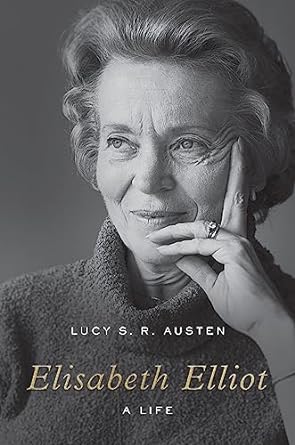
The first woman to be a principal speaker at Urbana (the annual student conference organized by InterVarsity Christian Fellowship), Elliot emphasized the central role that women had always played in world missions. But she presented that history as a counterpoint to “strident female voices” shouting for gender equality in American society. Missionaries like Gladys Aylward, Lottie Moon, and Betsy Stockton pursued their call “without the tub-thumping of modern egalitarian movements,” out of quiet, faithful obedience to Christ. “There is nothing interchangeable about the sexes,” she told the 14,000 students gathered at Urbana. “God has given us gifts that differ.”
According to Austen, Elliot had considered the arguments of Christian feminists like Letha Scanzoni in the late Sixties, but was speaking out against “women’s liberation” by the time the Seventies began. In 1975, for example, she told a Wheaton audience that her cross-cultural experience of distinct gender roles among the Waorani had helped convince her that hierarchy, not equality, was God’s design. She wrote against women’s ordination that summer in Christianity Today, then that fall attended the first meeting of the Evangelical Women’s Caucus in Washington, DC. Reporting on what she heard from speakers like Scanzoni, Nancy Hardesty, and Virginia Ramey Mollenkott, Elliot warned that the “Biblical feminist vision devalues the form in which divine revelation is given, and the devaluation of form leads ultimately to the destruction of content.” (By the way, Mollenkott and Scanzoni gave talks at Bethel in 1980 and 1981, respectively.)
Elliot issued her most widely-read response to feminism in 1976. Let Me Be a Woman consists primarily of essays offering marital advice to her engaged daughter. (Both Austen and Du Mez quote this sample maxim: “The more womanly you are, the more manly your husband will want to be.”) While Austen critiques the book’s “uneven” exposition of both Scripture and feminist writing and notes the “contradiction between Elliot’s own life and her attitude toward feminism” (p. 469), what Du Mez calls the “maternal voice” of Eliot (by “contrast to [Marabel] Morgan’s livelier prose”) helped make her “a celebrity within the evangelical subculture” (Jesus and John Wayne, p. 65).
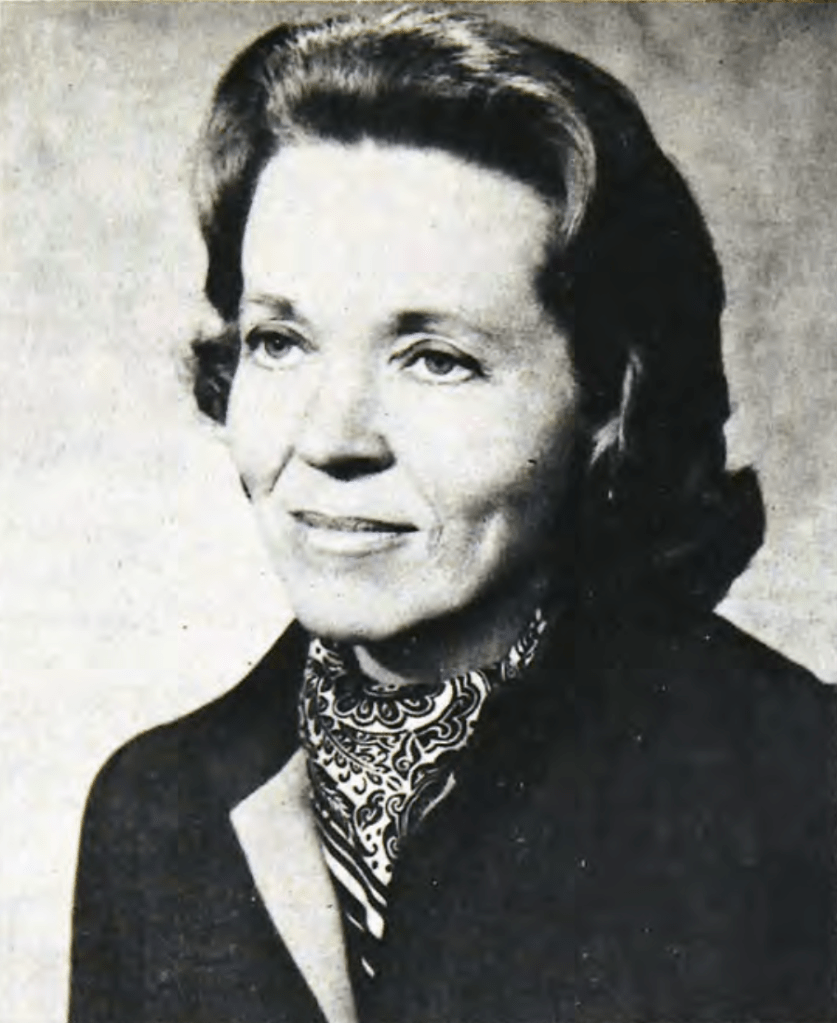
Elliot would marry for a third time, to hospital chaplain Lars Gren, at the end of 1977, seven months after giving that year’s commencement address at Bethel College. I haven’t yet come seen an archived copy of the speech, but Donna Otto read what she described as a transcript of it for a 2017 episode of her podcast, Modern Homemakers (starting 5:00 in).
Assuming it’s an accurate, complete transcription… On first listen, Elliot’s reflection on Luke 12:48 (“Every one to whom much is given, of him will much be required”) doesn’t seem to have much to say about women’s roles. But coming from the author of Let Me Be a Woman in the midst of the era’s debates about women’s liberation, I suspect that it’s the selection below that rankled some in the audience: (emphases mine)
Now, what have you been given? You have received a particular set of parents; you belong to a particular anthropological defined race; you are a certain color, a certain height, a certain build; you are either male or female. And you have no options at all about any of these things. They are the things given of your existence, the modes under which you are to operate. Now, you can protest or rebel for the rest of your life because someone else got what you wanted. Or you can accept your offering and gifts and give them back to God as He gave them to you. Offer them, as Paul says, “as a living sacrifice holy and acceptable to God” [Rom. 12:1]. The gifts we receive determine the requirements; the measure of your gifts is the measure of your responsibility…. Like the priests of old, we offer back only what we receive. And we offer it not with apologies, much less with complaints, but with thanksgiving. It is this body you offer: young or old, tall or short, black or white, whole or handicapped, male or female. Thank God for it, and give it back to him.
In a recent email interview, Lynn Baker-Dooley ’77 recalled wearing a pro-ERA button to that graduation ceremony, where “a few courageous faculty with tenure walked out in protest” of Elliot “telling the women to take their degrees to the home and be good wives and mothers.” (An English major who also studied music and political science, Baker-Dooley went on to become an American Baptist pastor and first lady of the University of Rhode Island. Her children later attended Bethel as well.)
I’d love to hear back from anyone else who was a student or employee at the time: What they remember of Elliot’s address, and if there was some kind of protest; how popular Elliot, Morgan, Schlafly, and other anti-feminist writers were at the time, and whether evangelical feminists like Scanzoni, Hardesty, and Mollenkott also found a hearing among Bethel students.
One goal of this blog is to help involve members of the Bethel community in doing the history of Bethel, so comments are always welcome! Just know that if you leave a comment at the project blog, I’ll take that as expressing your permission to quote it in the project.
 The Women of Bethel