I’m back from some sabbatical travels in Illinois and Alabama and ready to start writing again. I’ll have new material here next week, but first something I had meant to cross-post in late September from my Substack newsletter, “The Pietist Schoolman.” Better late than never!
In anthropology and other social sciences, it’s long been common for scholars to engage in “participant observation,” intentionally immersing themselves in the same communities they’re studying.
That’s not normally an option for historians. Even those of us who focus on the relatively recent past are typically examining it at a distance. Unless we’re conducting oral history interviews, we’re using evidence produced by others to understand people we don’t know and interpret events we didn’t experience. In my last project, for example, it felt strange even to exchange emails with Charles Lindbergh’s youngest daughter. Though I was glad for her insights, it was hard enough to wrestle with her father’s legacy in the solitude of the archive, let alone when the space between her past and my present collapsed.
But in my career, there’s been one big exception to that rule: I’ve periodically written institutional histories of my own university.
Even there, I’ve tried to keep things at a remove from my own experience. I first examined Bethel’s history because I wanted to understand its religious heritage, mostly via studying the life and thought of Carl Lundquist, who ended his long presidency when I was just seven years old. When we researched and wrote Bethel at War ten years ago, I stayed in the comfortably far-off time of the two world wars, while my student, Fletcher Warren, got to cover the post-9/11 era that was underway as I arrived at Bethel (2003).
But with my current project — a women’s history of Bethel — it’s inevitable that history and memory will start to overlap. After all, I can hardly leave out the last twenty-two years’ worth of Bethel’s history.
So while it’s not like I’ve chosen to embed myself in that community for the purposes of studying it, I do find myself facing some of the same challenges (and opportunities) as participant-observers. Here are four that I’ve thought about already…
1. On the plus side of having so many relationships within the community I’m studying… I think I’ve earned a great deal of trust among our various constituents, which hopefully will earn me a hearing for my more critical analyses. And while I’ve also been able to gather some information via cold calls, it’s been far easier to ask people that I already know to take part in our summer oral history project or to answer questions via email this fall.
But it felt surpassingly odd to sit across from interviewees this summer who would address me by first name, or allude to something I’d done or written. Like I was being written into history, not writing it.
And even when my own name is easy to keep out of the story (more below), it’s strange to stick with the academic convention of using last names when I’m writing about people I routinely address as Marion, Mauvalyn, and Miranda. When I completed this week’s series at my sabbatical blog on the changing gender demographics of our faculty, it felt painful to have to include a start and close year to the tenure of friends and colleagues who died too young or lost their jobs during the protracted economic crisis that started with the Great Recession.
2. At least when we’re talking about the Bethel of that recent era, I don’t have to work all that hard to understand the culture, ethos, language, and other background elements that normally take historians so long to absorb. I can pick up on allusions that would have slipped past outside observers, and I can fill in subtexts when meaning goes unstated.
Or can I? Again and again, I’ve reminded myself that my memories of this past don’t actually count as historical evidence. For example, I quite clearly remember the intra-faculty debates in 2012-13 over starting a Gender Studies minor. Our department was to cohost that program — which was approved — with Philosophy, and I personally advocated for it in public forums and behind the scenes. But I think it would be inappropriate for me to interject my own recollections or opinions should that story make the final cut.
I certainly want to limit the number of times I show up in the narrative. Fortunately, that’s much less likely to happen in a Bethel history that centers women. But that focus only raises another problem…
3. I should devote a full post to wrestling with the obvious question of whether or not a male history professor should write the women’s history of a university. Suffice it to acknowledge here that while I’m a participant in this past, I wasn’t a female participant in it. I worry that there are things I won’t see that another observer couldn’t miss.
So one reason I’ve focused so far on preserving this past more than analyzing or interpreting it is that I want to spend a long time listening to women’s voices before attempting to interject my own.
4. But once I get to the point of making meaning of this past, there’s the problem that I’m so close — relationally, emotionally, and spiritually, not just intellectually — to my subject.
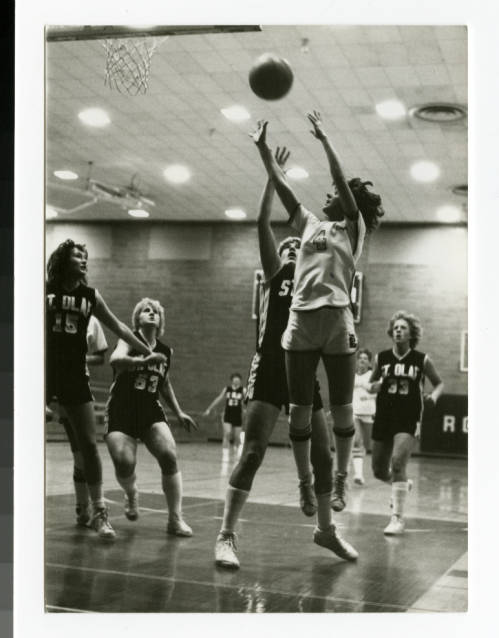
On the one hand, I won’t pretend that I’m dispassionate about what I’m doing. In general, Bethel history matters to me because Bethel itself matters so much to me. But then there are the special meanings of this particular topic… For example, as the parent of a teenaged daughter who plays volleyball and softball and runs track, I’m clearly inclined to celebrate the growth of women’s sports since Title IX — a phenomenon that some Bethel constituents initially opposed because they found women’s athletics “unfeminine.”
That’s not really a live issue in the year 2024, but other debates endure from Bethel past into Bethel present, and I can’t simply ignore my own stances on them. I don’t think it should be a surprise to anyone who follows my writing that I am what evangelicals call an egalitarian, not a complementarian. Though both positions can be found at Bethel and in its supporting denomination, let me reiterate what I wrote last summer, in one of the most-read issues of my Substack newsletter:
I believe that women share equally in the image of God, the gifts of the Holy Spirit, and the mission of the Body of Christ; as much as men, they can be called to the work of preaching and teaching and should be encouraged and enabled to fulfill those vocations through pastoral and other offices.
But while I’m passionate about that belief and try to live it out as a parent, church member, and teacher and advisor of Bethel students, I’m also going to strive to be objective in my coverage of opposing points of view. As an evangelical Christian, I doubt I’ll ever see eye to eye with former Bethel professors John Piper and Wayne Grudem when it comes to women in ministry, but as a Bethel historian, I’m certainly going to include their views when that debate flares up in our institution’s past — as when Piper and Grudem argued against their egalitarian colleagues in the pages of our student newspaper or denominational magazine in the Seventies and Eighties, or when one of them opposed the appointment of a woman to the Seminary faculty in the mid-Nineties. Of course, my readers will also hear from that professor and other women on that faculty (and in that student body), plus egalitarian college professors like Alvera Mickelsen, who helped organize Christians for Biblical Equality around the same time that Grudem and Piper founded the Council for Biblical Manhood and Womanhood.
My only non-negotiable here is that core belief that women share equally in God’s image, and the inherent worth and dignity that comes with it. That anthropology has important implications for Christian historians, as the author of our textbook for Bethel’s Intro to History course explains:
If we view colonial America, or any period in American history for that matter, from God’s eyes, then we get a very different sense of whose voices should count in the stories we tell… A history grounded in a belief in the imago Dei will not only neglect the elite and privileged members of society but also demand a fundamental reordering of the stories we tell about the human actors we meet in the past. (John Fea, Why Study History?, pp. 87, 88)
For example, reordering the Bethel story so that women are at its center — not men like me.
One goal of this blog is to help involve members of the Bethel community in doing the history of Bethel, so comments are always welcome! Just know that if you leave a comment at the project blog, I’ll take that as expressing your permission to quote it in the project.
 The Women of Bethel