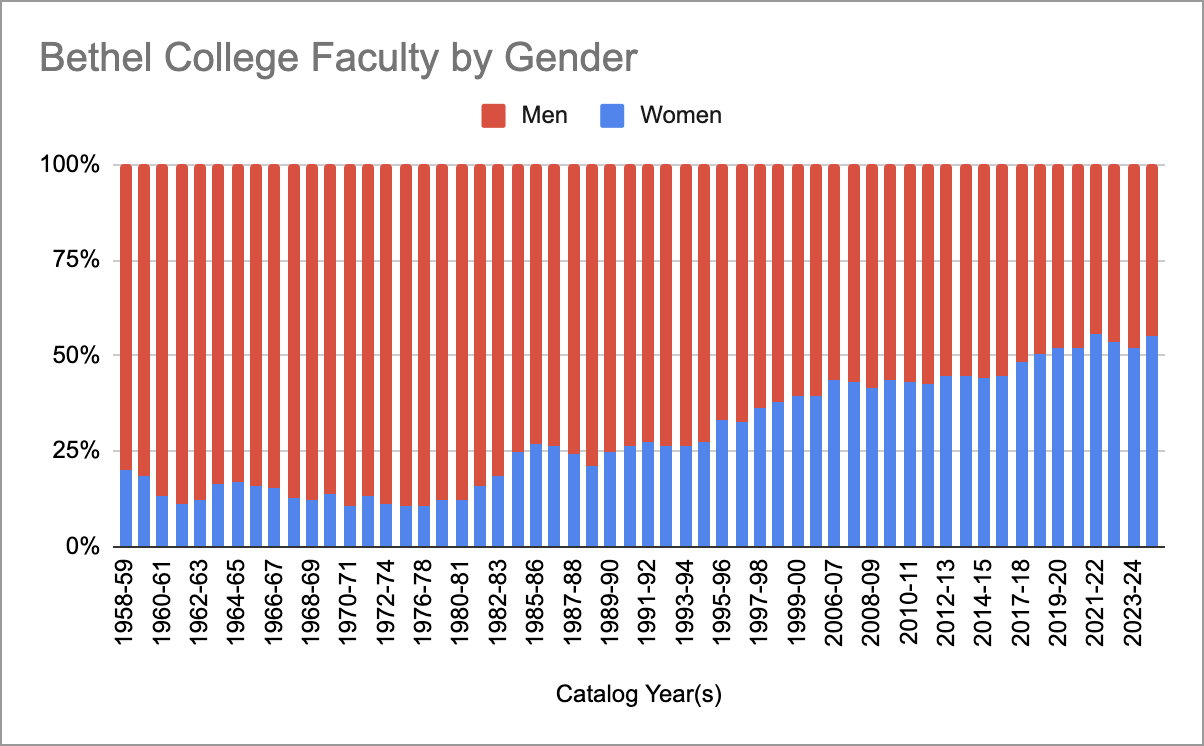
In part one of this brief series, we saw that the share of women on the Bethel College faculty actually declined through the Sixties before starting to grow slowly during the last years of the Carl Lundquist presidency. But thanks in large part to the launch of the Nursing major at the start of George Brushaber’s presidency, women accounted for 25% of Bethel’s full-time college professors by 1985-86.
Let’s pick up the story there…
The Height of the Brushaber Era, 1986-2001
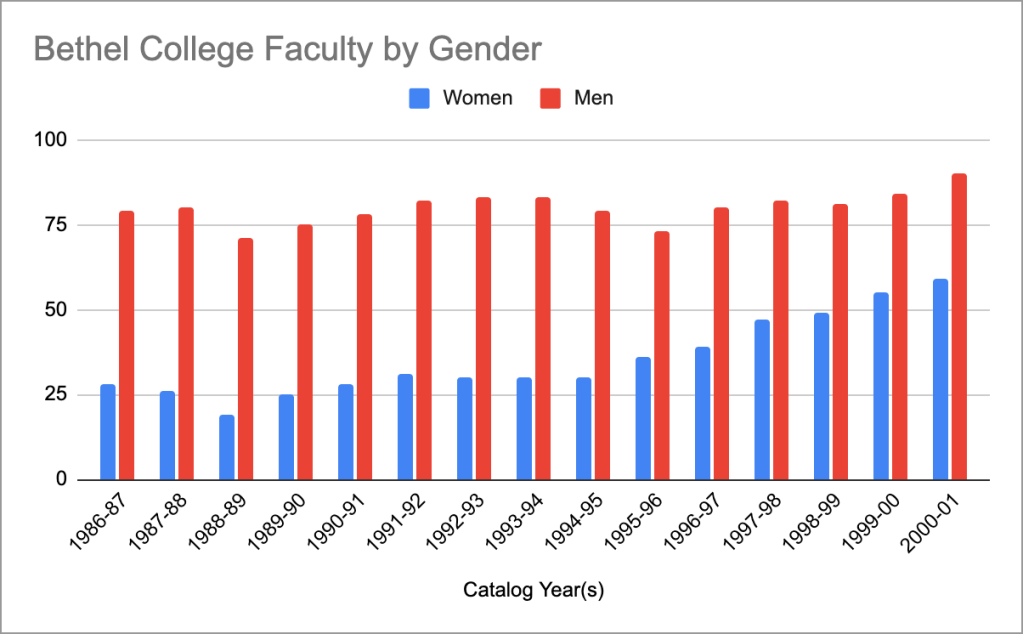
Note first just how large the College faculty became in these years. Although Brushaber started his tenure with an enrollment decline that necessitated painful cuts, the Nineties saw enormous growth, with nearly 150 full-time professors by the start of the 21st century — more than double the size of the faculty that moved to Arden Hills in 1972.
It’s evident that whether they were replacing (mostly male) retirees or adding new positions, faculty search committees were considering more and more female candidates, since women accounted for almost 40% of College professors by the start of the 21st century.
Sometimes that process reinforced existing strengths. Nursing and Education continued to employ women as professors more often than men, and Modern World Languages and Health & Physical Education kept moving in that direction. With the hires of Gretchen Wrobel (1988-present), Deb Harless (1989-2001, later Bethel’s first female provost), and Carole Young (1990-2015), the majority of Psychology faculty were women by the early Nineties. As Jeannine Bohlmeyer and Lorraine Eitel ended their careers, Marion Larson (1986-present) and Susan Brooks (1998-2022) started equally long tenures in an English department that also promoted adjunct instructor Mary Ellen Ashcroft to full-time status (1994-2005).
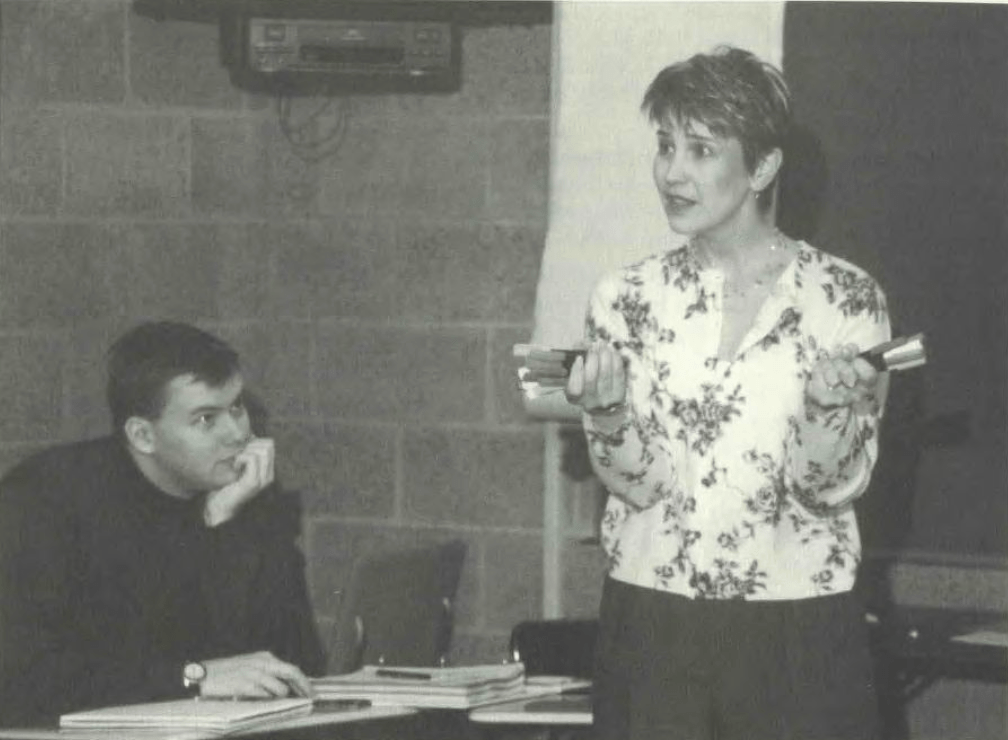
But new hires in this era also meant breakthroughs. Karen McKinney (Biblical and Theological Studies, 1996-2020), Stacey Hunter Hecht (Political Science, 1997-2015), Jenell Williams Paris (Anthropology and Sociology, 1998-2007), and Meg Zauner (Theatre Arts, 1998-2022) were the first full-time women in their fields in more than a decade — and the first to last for more than a few years. Two STEM departments had multiple women for the first time: Teresa DeGolier (1994-2023), Swee May Tang (1996-2001), and science educator Patricia Paulson (1999-2020) in Biology; and Patrice Conrath (1988-2022) and Carol Thompson (1995-1997) in Math and Computer Science, respectively. My own department had employed Shirley Mullen and Margie Koch as adjunct history instructors in the Seventies and Eighties, but Diana Magnuson broke new ground when she returned full-time to her alma mater (1994-2021), both teaching U.S. history courses and serving as archivist for Bethel and its denomination.
To some extent, I suspect that the rising share of women faculty also reflects the Brushaber-era launch of adult and graduate programs, whose catalogs I haven’t yet analyzed but whose instructors often showed up on the College list. Not only were those programs mostly in fields that had historically featured female students and professors (e.g., education, health care, counseling), but my initial impression — reaffirmed by a couple of comments in our summer oral history interviews — is that women played prominent roles in the leadership and founding faculty of what became the College of Adult and Professional Studies (CAPS) and Graduate School (GS).
The First Years of Bethel University, 2006-present
Before I get to our final graph, note the gap in our timeline. Alas, four of the five college catalogs from 2001 to 2005 haven’t been added to the Digital Library, and the other (2004-05, the first year of Bethel University) doesn’t include a faculty list. Once I’m in the archives themselves, I’ll try to fill in that hole with physical copies. In the meantime, 2006-07 is available from the Digital Library and Bethel’s own institutional archive of catalogs picks up the following year. That resource will also let me fill in Seminary, adult, and graduate data as my research continues, but for our last chart I’ll stick with faculty listed in CAS catalogs.
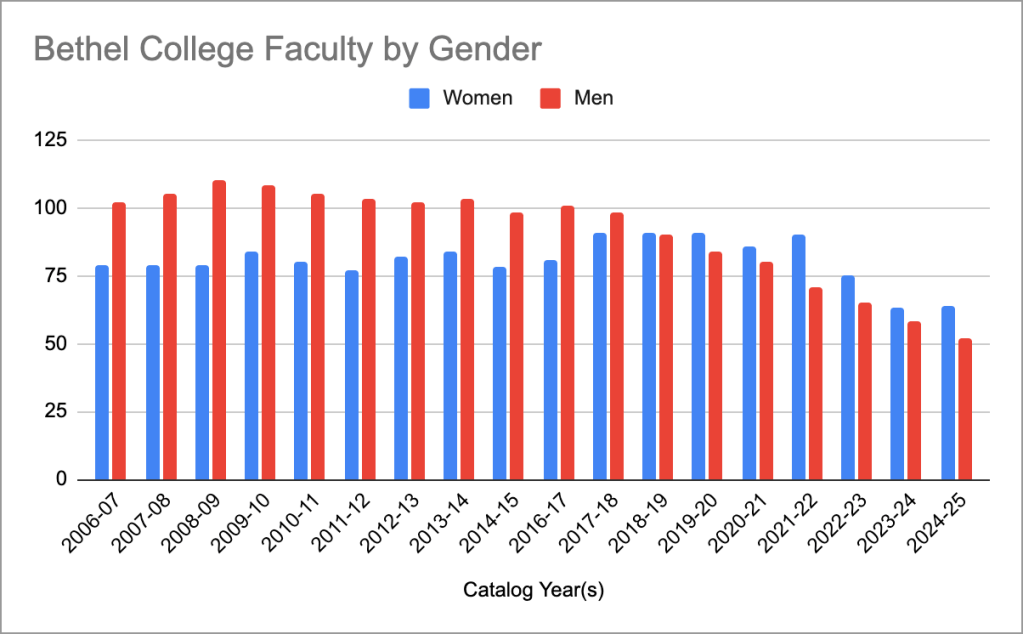
(Note that I had to skip 2015-16. That’s the year when catalog drafters started to put full-time, adjunct, and emeritus faculty together into a single list… but failed to make clear consistently which category each professor fit into. Things improved by 2016-17, though it’s still sometimes uncertain when professors moved from active to emeritus status, so take my more recent retirement dates with a grain of salt.)
For the record, it was 2018-19 when the balance tilted to (slightly) more women than men, with the former number just clearing ninety for three straight years. In the current CAS catalog, 55% of the full-time faculty are women.
But the backdrop for the story of women making up the majority of Bethel professors is the larger story of that college’s faculty shrinking after the Great Recession, as declining enrollment and rising costs forced a succession of position and program eliminations. There are 40% fewer full-time faculty listed in the 2024-25 CAS catalog than in the peak year of 2009-10.
As part of the larger narrative of Bethel’s faculty finally reaching gender parity amid a larger numerical decline, I’d also note a few more striking sub-plots:
• For the first half-century of Bethel’s four-year college (est. 1947), no departments were slower to hire women full-time than Chemistry and Physics. But early in the 21st century, Ashley Mahoney (2001-2021) and Alyssa Hamre Kontak (2012-present) broke those particular glass ceilings. Then both departments have made multiple female hires since then, including Angela Stoeckman (Chemistry, 2015-present), Julie Hogan (Physics & Engineering, 2017-present), and Karen Rogers (who helped launch Bethel’s engineering programs between 2017 and 2023). At the same time, Biology joined Psychology as a science department with majority-female faculties, hiring eight women since 2004.
• I somehow failed to mention Leta Frazer (1982-2019) last time, as the first woman hired full-time to teach Speech/Communication. But as the present-day Communication Studies department grew into one of the largest on campus, its leaders have included long-serving women like Peggy Kendall (1999-present) and Nancy Brule (2004-present.)
• Although Carol Armstrong Pass taught philosophy courses from 1981 to 1990, that department was the last humanities program to hire women full-time: Sara Shady (2002-present) and Carrie Peffley (2007-2021). Philosophy eventually merged with History and Political Science, which continued to hire women in the 21st century: AnneMarie Kooistra (History, 2005-present), Amy Poppinga (History, 2012-2023, with adjunct stints on either side of those dates), and Lynn Uzzell (this fall’s new hire in Political Science). Business, another department that was initially dominated by male faculty, added several female professors over the past 20+ years — including department leaders like Bethany Opsata (2001-present), Mary Ann Harris (2005-present), Joyce LeMay (2006-present), and Mauvalyn Bowen (2016-present).
Bowen (profiled in this 2019 video by student Joe Hiti) and LeMay have also served as CAS faculty president
• Finally, it’s well worth reiterating that the Education and Nursing departments continued to be engines of growth for faculty women in this era. How to count those professors given my previous stipulations is a bit tricky, since both departments’ faculties span the divide between traditional undergraduate and adult/graduate programs. But for 2024-25, female professors in Education (5) and Nursing (15) account for just over 30% of the women on the full-time CAS faculty, and almost all of the many adjunct/clinical instructors working for those programs are also women.
One goal of this blog is to help involve members of the Bethel community in doing the history of Bethel, so comments are always welcome! Just know that if you leave a comment at the project blog, I’ll take that as expressing your permission to quote it in the project. (To my usual boilerplate here, I’d just add that I’d be especially happy to hear from former colleagues or students who want to share stories about women faculty from various eras!)
 The Women of Bethel