When do you start the story of the women of Bethel University?
Most Bethel stories trace their way back to 1871, the year that sailor-pastor-scholar John Alexis Edgren founded a small seminary for Swedish Baptists. But it took another eight years for that Chicago-based school to enroll its first women… then women virtually disappeared from its student roster after Carl Gustaf Lagergren took over as dean… only for the seminary to merge in 1914 with Bethel Academy, a secondary school in St. Paul that had been coeducational since its 1905 founding. Against Lagergren’s objections, Bethel soon established a Bible and Missionary Training School that primarily catered to women and was headed by Esther Sabel, who taught Bible at Bethel until her retirement in 1958.
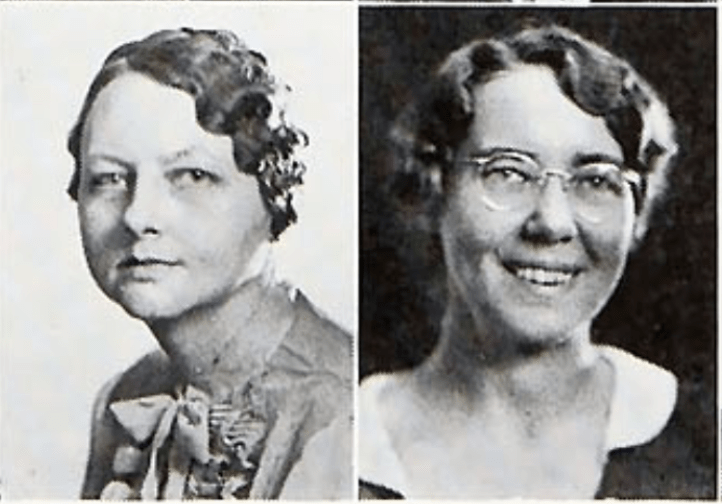
At some point in our final narrative, I’m sure I’ll expand on those stories — and even push back deeper in time to explain why Baptists started to break away from Sweden’s state Lutheran church in the 1840s, then began migrating to the United States just before the American Civil War. (For that matter, the debates over women’s roles in church, family, and society that will be so central to this project extend back decades and centuries in the history of Christianity.) And I’ll pay some attention to the role that women — students, but also pioneering faculty like Sabel and Effie Nelson — played as Bethel developed a junior college before World War II, then a four-year college after that conflict.
But for reasons both practical and theoretical, I’m planning to focus this project on the period of Bethel history starting in 1972.
Practical. If I had multiple years to work on this project, I might attempt a more comprehensive history. But even if I postpone most of my writing until early 2025 and dedicate my fall 2024 sabbatical to research, having just a few months demands that I zoom in on a narrower slice of Bethel history.
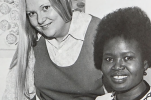
That more modern focus also means that I can elude a problem that complicated my World War I and World War II essays in the 2014 Bethel at War project: a relative scarcity of sources. The period since the Seventies is amply documented by archival and published sources, plus Sam Mulberry, Ellie Heebsh, and I were able to add to that historical record this summer by interviewing living women who had studied, taught, and otherwise served at Bethel. Two of them had been Bethel students in the Sixties, but most of their stories came from later in time.
Theoretical. Most importantly, we should start in 1972 because it marked a decisive turning point in the history of Bethel University — and of its women.

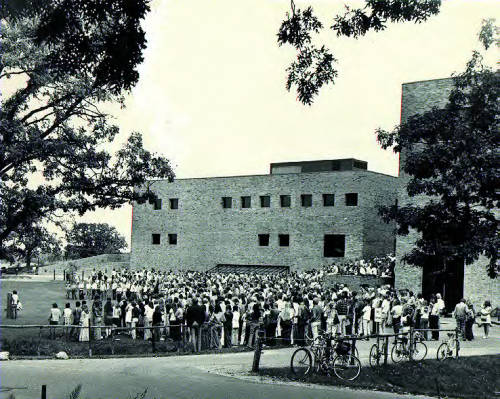
1972 was the year that the College began to operate on the lakeside campus in Arden Hills where the Seminary had already relocated — and where Bethel is primarily based to this day. While there’s surely continuity with the “Snelling Avenue” Bethel, the move to the suburbs marked a decisive transition in the culture, community, and operation of Bethel. If one goal of this project is to use history to help guide us in the present, then that “usable past” is most likely to be found on the Arden Hills campus.
That would be enough for me. But as it happens, 1972 also serves as a landmark moment in at least two of the most important stories we’ll tell in this project.
• First, as the year that the U.S. Congress adopted Title IX, choosing 1972 reminds us from the start of the central role that sports play in the women’s history of most American colleges and universities — though we’ll see that it would take many years for anything like gender parity to characterize Bethel athletics.
• Second, 1972-73 was the senior year for a Bethel College student named Carol Shimmin. The seminary courses she was allowed to take that year marked the first steps on her journey as the first woman to earn an M.Div. degree at Bethel, a difficult path that more and more women would follow in the years to come.
In both cases, starting in 1972 also helps underscore that while Bethel’s move to the suburbs fed the sense of the school as inhabiting a “bubble” separate from the world, Bethel was not insulated from larger trends in American society. 1972, after all, was the year that Democratic congresswoman Shirley Chisholm became the first woman to seek her party’s nomination for president and the U.S. Senate sent the Equal Rights Amendment to state legislatures for possible ratification.
Debates over gender equality were also finding their way into evangelical institutions in the Seventies. By the time Carol Shimmin became one of the first women ordained by the Evangelical Covenant Church, opposition to women’s ordination had already prompted conservatives to form what became the Presbyterian Church in America. As authors like Nancy Hardesty, Letha Dawson Scanzoni, and Patricia Gundry brought feminism into the evangelical mainstream, Bethel faculty of the time would go on to found leading organizations for both complementarianism and egalitarianism.
One goal of this blog is to help involve members of the Bethel community in doing the history of Bethel, so comments are always welcome! Just know that if you leave a comment at the project blog, I’ll take that as expressing your permission to quote it in the project.
 The Women of Bethel